BNG: List of instant-speed tricks

This is a list of all the instant-speed tricks in the format. The first table has the spell names while the second one has abbreviated spell descriptions in case you don’t remember what the spell does. Note that the latter table may not accurately represent all uses of the spell and often leaves out certain things. Also, I sometimes make mistakes while filling out these tables; please let me know if you spot any issues.

Both tables categorize the tricks by converted mana cost, color, and rarity. Unless specified otherwise, each colored spell has one colored mana in its mana cost with the rest being generic mana, so a 3-mana white spell with no explicit cost has a mana cost of 2W. I also specify mana costs if the spell has X in its mana cost, is multicolored, or costs more than the column it is specified in. Spells in bold can leave a creature in play, e.g., flash creatures, spells that create token creatures, or spells that allow you to cast creatures at instant speed.

Here’s how to interpret the second table:

  • Abbreviations used: A (artifact), attkr (attacker), blkr (blocker), bounce (return permanent to owner’s hand), C (creature), CMC (converted mana cost), counter when used as a verb (counter a spell), dmg (damage), draw X (draw X cards), E (enchantment), flyer (creature with flying), freeze X (tap X and it doesn’t untap next turn), gain X (gain X life), I (instant), L (land), lose X (lose X life), opp (opponent), opp’s X (X controlled by opponent), P (player or power, depending on context), prot (protection), PW (planeswalker), reanimate (return permanent from the graveyard to the battlefield), redirect X dmg from A to B (next X dmg that would be dealt to A is dealt to B instead), regen (regenerate), S (sorcery), sac (sacrifice), T (toughness), your X (X you control).
  • Spells that confer an effect (+X/+Y, -X/-Y, hexproof, first strike, prot from a color, etc.) last until end of turn unless specified otherwise.
  • Spells can target any legal permanent or player unless otherwise specified, e.g., X dmg without any qualifiers means that the spell does X damage to any creature or player.
  • Spell descriptions sometimes mention other spells as a way to describe their effects, e.g., Steam Augury is described as a flipped Fact or Fiction to avoid having to write the full description.
BNG: Compact spoiler

This is a 7-page version of the full Born of the Gods spoiler. The card image gallery at DailyMTG is 29 pages and the printable spoiler at MTGSalvation is 46 pages so I’m hoping this saves trees, and it’s certainly easier to carry around in your pocket.

THS: Archetype wheel

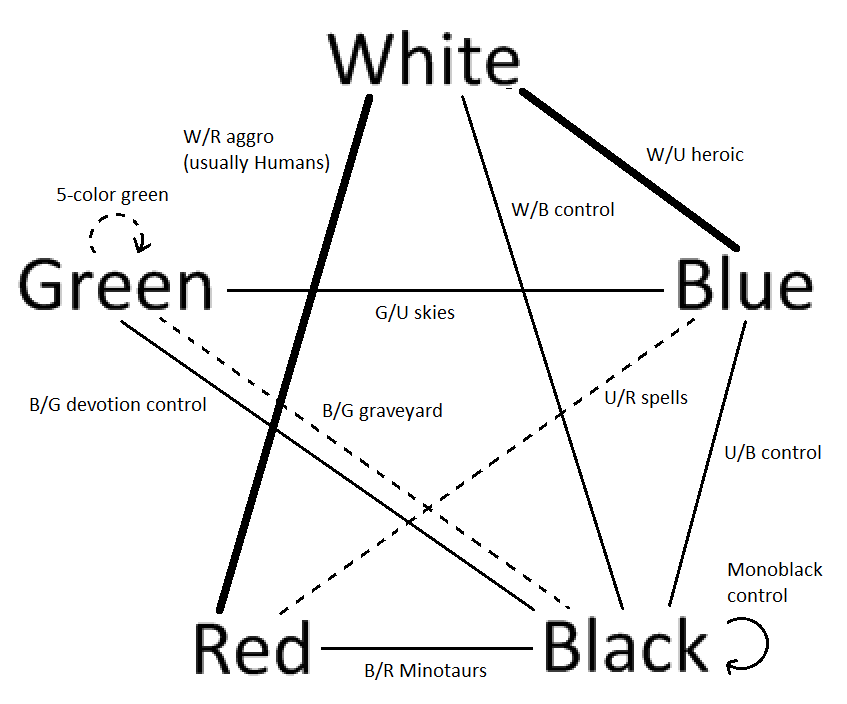
Theros Archetype Wheel

If we take all the archetypes discussed in my post summarizing archetypes in Theros draft and plot them on a color wheel, this is what we get. A line between 2 colors indicates that there is an archetype that spans those 2 colors (monocolor and 5-color decks are indicated by an arrow from the color to itself), and is labeled with the archetype name. A thick line indicates that the archetype is more likely to come together in a draft because it relies on fewer key cards, requires fewer uncommons/rares, or shares cards with fewer other archetypes; these are the archetypes that were bolded in that post and can usually support 2 drafters at an 8-man draft. Archetypes that rely on specific rares, require multiple copies of a common/uncommon in order to function, or that share cards with multiple other archetypes are riskier to attempt and are indicated with thinner lines; these archetypes can usually support 1 drafter per table. Archetypes that I haven’t drafted yet are indicated with a dashed line; these usually won’t have any drafters since they need multiple uncommons/rares in order to function. If you want to read more about a particular archetype, that post has a list of the key cards for each archetype and links to more detailed descriptions.

The purpose of the archetype wheel is to help us see visually which colors support the most number of archetypes and, therefore, offer the most flexibility. This can help when choosing between 2 cards of similar power levels in the early stages of a draft. For instance, black supports the most number of color combinations and can be paired with any of the other colors, or be played on its own if you get enough black cards. However, most of the B/X decks are similar and rely on the same core of black cards, so you have to compete more with players for those key cards. Green allows the least number of color combinations and so offers the least flexibility; this is one of the reasons it is the least popular color in Theros. Note that white can support more drafters than it might seem because W/U and W/R can often support 2 drafters each. This means that you should consider taking a white or black card over a blue or red card of equal quality early in a draft, and that you should avoid taking a green card unless it’s a bomb.

This is roughly in line with my color preferences in Theros draft. Getting passed a Favored Hoplite or Phalanx Leader will almost certainly put me in W/X, getting passed a Gray Merchant of Asphodel or Keepsake Gorgon will usually put me in B/X, and I will likely try to play or splash a Sea God’s Revenge. Early in a draft, I will also usually take Coordinated Assault, Fanatic of Mogis, Kragma Warcaller, and Battlewise Hoplite over everything except in-color bombs and removal but I won’t work as hard to end up with a deck that can play them. On the other hand, very few cards can cause me to play green in this format since I’ve had consistently poor performance with G/X decks, even when I am one of the only green drafters at the table. (Or perhaps I just haven’t figured out how to draft green in this format — a friend recently said he’d won several drafts with monogreen and G/W heroic decks with a curve ending at 3.)

Weaving all this information together, we can conclude that a typical draft will likely have:

This means that a typical draft will have 6 aggro decks and only 2 control decks. There will usually be 4-5 white decks, 3-4 blue decks, 3 black decks, 3 red decks, and 1-2 green decks. White and red only appear in 1 control deck each, W/B control and U/R spells respectively, and the latter is unlikely to come together in most drafts, so you don’t usually want to use early picks to take control cards in those colors. There’s also only 1 black aggro deck (B/R Minotaurs), so you don’t usually want to use early picks to take aggressive cards in those colors.

THS: G/U skies

I had a chance last night to draft one of the archetypes I’d theorized about in my last post. After taking a Curse of the Swine from my first pack, I got passed a Mistcutter Hydra. (I guess the person to my right dislikes green even more than I do in this format!) After a few packs with uninspiring choices, I saw a Vaporkin and a Voyaging Satyr midway into the pack; knowing that G/U is more likely to be a skies deck than a ramp deck helped me realize that Vaporkin was the better pick. The prior analysis also helped me realize I should draft the Warriors’ Lesson I was passed late in the pack, even though it is a card I usually avoid (it often ends up just cycling, and is useless if you don’t have creatures with evasion). It turned out to be excellent in the deck but it might not have occurred to me to draft it if I hadn’t described the archetype in my last post. (Btw, don’t forget to gain life if you also have Horizon Chimera on the table.)

One of the weakness of G/U is that it lacks hard removal, but my deck lacked even the bounce and counterspells that help compensate for that. As a result, I decided to splash white for the Elspeth Sun’s Champion that I’d opened in pack 2 and a Divine Verdict. The final decklist was:

2 Vaporkin
2 Voyaging Satyr
1 Nimbus Naiad
1 Opaline Unicorn
2 Agent of Horizons
1 Wavecrash Triton
2 Horizon Chimera
1 Staunch-Hearted Warrior
1 Nessian Asp
1 Mistcutter Hydra
1 Horizon Scholar
= 15 creatures

2 Warriors' Lesson
1 Triton Tactics
1 Traveler's Amulet
1 Nylea's Presence
1 Divine Verdict
1 Elspeth Sun's Champion
1 Curse of the Swine
= 8 non-creatures

1 Prowler's Helm
1 Fleetfeather Sandals
2 Guardian of Meletis
2 Shredding Winds
2 Commune with the Gods
1 Vulpine Goliath
1 Satyr Hedonist
3 Benthic Giant
1 Mnemonic Wall
1 Spellheart Chimera
1 Demolish
1 Boon of Erebos
1 Viper's Kiss
1 Forest (foil)
= 19 sideboard cards

This list conforms somewhat to the G/U skies outline that I laid out in my last post, but lacks the early defense and bounce/counterspells that I’d believed were an important component of such decks. However, I did have mana acceleration in place of the early defense, and I had some hard removal in place of bounce/counterspells.

The deck went 3-1. Elspeth Sun’s Champion won a couple of games and Divine Verdict was also excellent, and was particularly devastating when the white mana for it came from Prized Unicorn or Nylea’s Presence since my opponent would usually play around Divine Verdict in that case if they hadn’t already seen Plains previously. Elspeth Sun’s champion did languish in my hand during one game, but was fine the rest of the time due to the Voyaging Satyrs which often provided the second white mana.

THS: Summary of archetypes

Here’s a summary of the M14 archetypes I’m aware of, along with some of the key cards for each archetype. (If I’ve missed any archetypes, feel free to post them in the comments.) Archetypes in bold require fewer uncommons/rares or have more substitutes, and are therefore more likely to come together in a draft. These archetypes may also be able to support more than one drafter at an 8-person draft. “+” is used to separate different categories of cards required for the archetype. Italics denote cards that are secondary for this archetype and should usually only be drafted once you have a number of the non-italicized cards listed. [] indicates that a card is rare or mythic.

Aggro decks (usually W/X):

  • W/U heroic: Favored Hoplite, Phalanx Leader, Wingsteed Rider, Battlewise Hoplite, Vaporkin + creatures with bestow + Auras (Ordeals, cantrip Auras, Aqueous Form) + tricks (Gods Willing, Dauntless Onslaught, Triton Tactics) + Divine Verdict/bounce
  • R/W aggro (usually Humans): Favored Hoplite, Phalanx Leader, Wingsteed Rider, Akroan Hoplite, Priest of Iroas + Human Lords (Cavalry Pegasus, [Titan of Eternal Fire]) + creatures with bestow + Auras (Ordeals, cantrip Auras) + tricks (Coordinated Assault, Gods Willing, Dauntless Onslaught, Titan’s Strength) + removal (Divine Verdict, red burn) + finishers (Fanatic of Mogis, Portent of Betrayal)
  • B/R Minotaurs: Minotaur Lords (Kragma Warcaller, [Rageblood Shaman]) + Minotaurs (Fanatic of Mogis, Deathbellow Raider, Minotaur Skullcleaver, Borderland Minotaur) + removal (red burn) + tricks (Coordinated Assault, Boon of Erebos, Titan’s Strength)
  • G/U skies: creatures with evasion (Vaporkin, Nimbus Naiad, Agent of Horizons, Horizon Chimera) + Warriors’ Lesson + defense (Omenspeaker, Sedge Scorpion) + bounce/Dissolve

Control decks (usually B/X):

  • Monoblack: Gray Merchant of Asphodel, Keepsake Gorgon, Disciple of Phenax, Insatiable Harpy + early defense (Baleful Eidolon, Returned Phalanx) + removal (Pharika’s Cure, Sip of Hemlock) + Read the Bones
  • W/B control: monoblack cards + win conditions ([Triad of Fates], Sentry of the Underworld, Evangel of Heliod, Scholar of Athreos) + removal (Last Breath, Divine Verdict)
  • U/B control: monoblack cards + Shipwreck Singer (ideally with Triton Tactics) + bounce/Dissolve + Opaline Unicorn + defense (Omenspeaker, Coastline Chimera) + win conditions (Horizon Scholar, Prescient Chimera)
  • B/G devotion control: monoblack cards + Nemesis of Mortals, Nessian Asp, Pharika’s Mender + defense (Sedge Scorpion, Leafcrown Dryad, Nylea’s Disciple) + mana acceleration (Voyaging Satyr, Burnished Hart, Opaline Unicorn) + Time to Feed
  • B/G graveyard (untested): Nemesis of Mortals, Pharika’s Mender, [Nighthowler], [Whip of Erebos] + Commune with the Gods, Returned Centaur + defense (Sedge Scorpion, Leafcrown Dryad, Nylea’s Disciple)
  • 5-color green (untested): bombs across multiple colors + mana fixing (Burnished Hart, Prized Unicorn, Nylea’s Presence, Traveler’s Amulet, Shimmering Grotto) + defense (Sedge Scorpion, Leafcrown Dryad, Nylea’s Disciple)
  • U/R spells (untested): spells-matter cards (Flamespeaker Adept, [Meletis Charlatan], Spellheart Chimera, Prescient Chimera, Mnemonic Wall) + card advantage ([Steam Augury], Triton Fortune Hunter, Thassa’s Emissary) + bounce/removal/Dissolve + defense (Omenspeaker, Crackling Triton, Wavecrash Triton) + Titan’s Strength

THS: W/B control and Triad of Fates

I hadn’t had much success with control deck in Theros until recently when I did reasonably well with a couple of B/X control decks (2 W/B and a U/B/w deck). Each had at least one Gray Merchant of Asphodel and would have been a monoblack deck in the early days of Theros when it was still possible to draft multiple Gray Merchants of Asphodel. However, white and blue both offer cards that work well in a B/X control deck.

White offers some excellent defensive creatures (Scholar of Athreos, which also serves as lifegain and a win condition), removal (Divine Verdict, Last Breath), lifegain (Hopeful Eidolon, Lagonna-Band Elder), and win conditions (Evangel of Heloid, Sentry of the Underworld), and lets you run Gods Willing alongside Boon of Erebos. I’ve also found Triad of Fates to be seriously undervalued and have often been passed it late by players who see it as too slow. While it is certainly subpar in an aggressive W/B deck, it can be very powerful in control decks that are able to survive long enough to use its white ability to “blink” an Evangel of Heliod, Disciple of Phenax, or Gray Merchant of Asphodel. (Abhorrent Overlord and Ashen Rider are also excellent targets for the white ability, but if you manage to cast either of those, you’re probably already winning the game.) The deck tends to be heavier black than white, so you might end up picking Pharika’s Cure over Wingsteed Rider, especially since you are likely to have fewer targeting effects than an aggressive W/B deck.

Blue also offers excellent defensive creatures (Omenspeaker, Wavecrash Triton, and Coastline Chimera, which is playable even without white in a control deck), removal (Shipwreck Singer, Griptide, Sea God’s Revenge, Voyage’s End), counterspells (Annul, Dissolve), and win conditions (Horizon Scholar, Nimbus Naiad). As with white, it is the multicolor Shipwreck Singer that makes this a powerful color combination and, as we’ve seen previously, it is powerful multicolor cards like these that can make it worth delaying selection of a second color if you start out in either blue or black. (Also, remember to keep an eye out for Triton Tactics once you’ve drafted Shipwreck Singer.)

I tend to prefer W/B over U/B because Scholar of Athreos, Sentry of the Underworld, and Triad of Fates are all powerful cards that fill multiple roles, helping you stabilize and then serving as win conditions once you’ve locked down the board. In fact, a U/B control deck I drafted recently splashed white for Scholar of Athreos and Sentry of the Underworld when I found myself short a couple of cards after switching from W/B to U/B in pack 2 of the draft. Triad of Fates is a riskier splash in such cases because it doesn’t immediately impact the board when played, but it still does provide the ability to retrigger some strong enters-the-battlefield abilities on blue creatures (Horizon Scholar, Omenspeaker, and Mnemonic Wall).

THS: Portent of Betrayal and sacrifice effects

Whenever a set has a common card like Portent of Betrayal that allows you to steal a creature temporarily, I always look to see how many sacrifice effects the set has. That lets me determine whether the card can be used in control decks as well as aggro decks, which can affect how highly I value the card during a draft. In conjunction with a sacrifice effect, such cards allow you to remove any creature without hexproof/protection, regardless of size, regeneration, and/or indestructability, and so it can be worth the effort of trying to assemble the combo.

Unfortunately, Theros provides only 2 effects that lets you sacrifice creatures you control: Rescue from the Underworld, which requires 9 mana to use with Portent of Betrayal (but lets you keep the creature for the rest of the game), and Tymaret the Murder King, which is a rare. Triad of Fares also interacts well with Portent of Betrayal but is also a rare and requires a 3-color deck. Finally, Shipwreck Singer lets you kill an X/1 creature if you can attack with it but again requires a 3-color deck.

Theros also has 5 creatures (including Tymaret the Murder King) that have abilities that allow you to sacrifice them. While Portent of Betrayal can be used against these cards without a separate sacrifice effect, it requires a fair bit of mana to be able to steal the creature and sacrifice it in the same turn. It also requires mana of the right color, unless you’re stealing Burnished Hart. Most importantly, these 5 creatures are not particularly scary and you’ll rarely be happy spending a bunch of mana to get rid of them.

Given this, you should only draft Portent of Betrayal if you’re drafting an aggressive red deck that can make good use of its effect, and not for the potential combo with a sacrifice outlet. Most R/X decks in Theros are aggressive, but some U/R and R/G decks are more controlling and Portent of Betrayal is not a good fit for those decks.

THS: Flamespeaker Adept

I’d evaluated Flamespeaker Adept as exceptional in both my original and updated evaluations. However, it’s never actually been stellar for me in practice because I’ve never had enough scry effects to go with it. I’ve wondered whether this is because I haven’t been valuing scry effects highly enough, whether I haven’t been in the right color pairs to make best use of the card, or whether it is unavoidable because Limited deck cannot run enough instants/sorceries to make good use of the card.

Here are the scry effects in Theros by color. They’re common instants with one-time effects unless otherwise noted:

  • White (2 commons + 1 uncommon): Battlewise Valor, Gods Willing, Vanquish the Foul (uncommon sorcery)
  • Blue (6 + 3 + 1 rare + 1 mythic): Aqueous Form (enchantment/recurring), Lost in Labyrinth, Omenspeaker (creature), Prescient Chimera (creature/recurring), Stymied Hopes, Voyage’s End, Dissolve (uncommon), Horizon Scholar (uncommon creature), Sea God’s Revenge (uncommon sorcery), Prognostic Sphinx (rare creature/recurring), Thassa God of the Sea (mythic enchantment creature/recurring)
  • Black (1): Read the Bones (sorcery)
  • Red (4 + 1): Portent of Betrayal (sorcery), Rage of Purphoros (sorcery), Spark Jolt, Titan’s Strength, Magma Jet (uncommon)
  • Green (0 + 1): Artisan’s Sorrow (uncommon)
  • Multicolor (0 + 1 + 1): Battlewise Hoplite (uncommon creature/recurring), Reaper of the Wilds (rare creature/recurring)
  • Artifact (0 + 1): Witches’ Eye (uncommon artifact/recurring)
  • Land (0 + 0 + 5): 5 Temples (rare lands)

I’m usually not excited to be playing Vanquish the Foul, Lost in Labyrinth, Stymied Hopes, Rage of Purphoros, Spark Jolt, or Witches’ Eye maindeck. Excluding those cards, blue has the most scry effects by far (13.7 in the average draft), followed by red (6) and white (4.8). Blue also has 5 of the 7 recurring scry effects in Theros: Aqueous Form, Prescient Chimera, Prognostic Sphinx, Thassa God of the Sea, and the multicolor Battlewise Hoplite. Perhaps most importantly, blue has all but 1 of the creatures with scry effects and it is these creatures that allow you to get a critical mass of scry effects while still running enough creatures.

It might be possible to draft an occasional R/W deck that makes good use of Flamespeaker Adept, but it seems that the best color pair for it is U/R, perhaps in a deck that also runs Spellheart Chimera, Mnemonic Wall, and Meletis Charlatan to take advantage of the higher than usual number of instants and sorceries in the deck. If you’re drafting that deck, keep an eye out for Aqueous Form and Prescient Chimera once you have a couple of Flamespeaker Adepts. (Aqueous Form turns Flamespeaker Adepts into an unblockable 4/3 that scrys on each attack, which seems strong in a format that has relatively little removal.) However, this deck is specific enough that Flamespeaker Adept probably just merits a rating of good rather than exceptional.

THS: Tap abilities and untap effects

Theros has a number of untap effects, all of which are in blue and green: Breaching Hippocamp, Triton Tactics, Savage Surge, and Prophet of Kruphix. (There is also Portent of Betrayal in red, but it will rarely be used just to untap a creature you control.) However, the set seems to lack creatures with powerful tap abilities that you can reuse with these untap effects. Let’s examine the tap abilities in the set to determine whether that perception is correct.

Here’s a list of all the creatures in Theros that have activated abilities that involve tapping the creature:

  • White: Ephara’s Warden (common) which is unplayable
  • Blue: Meletis Charlatan (rare) which is sufficiently mana intensive that you can’t usually use it twice in a turn
  • Red: Titan of Eternal Fire (rare) which allows Humans to tap for 1 damage
  • Green: Voyaging Satyr (common), Karametra’s Acolyte (uncommon), Sylvan Caryatid (rare)
  • W/B: Triad of Fates (rare)
  • U/B: Shipwreck Singer (uncommon)
  • Artifact: Opaline Unicorn (common), Witches’ Eye (uncommon)

Of these, the only cards whose effects are particularly compelling are Karametra’s Acolyte, Triad of Fates, and Shipwreck Singer, although reusing Titan of Eternal Fire’s effect is reasonable if you don’t have enough Humans. Triad of Fates offers the most interesting interaction since you can exile or save a creature that doesn’t already have a fate counter on it, but it also requires a 3-color deck (W/U/B or G/W/B) which is not a common occurrence in Theros drafts. I once used Shipwreck Singer + Triton Tactics to wipe out much of an opponent’s army so I know that combo has potential, but Breaching Hippocamp costs too much mana to be an effective combo with it and the other untap effects require green mana and so also require a 3-color deck.

If your devotion to green is 3 or more, Karametra’s Acolyte can generate additional mana using Savage Surge. However, Karametra’s Acolyte costs 4 mana, so this means you already have access to at least 7 mana, which is enough for most effects in Theros. The set only has 3 spells that cost more than 7: Ashen Riders, Boulderfall, and Colossus of Akros. No bestow abilities cost more than 7, and only 6 monstrosity abilities cost than much: Shipbreaker Kraken (8), Hythonia the Cruel (8), Stoneshock Giant (8), Nemesis of Mortals (9, although it will usually cost 7 or less), Colossus of Akros (10), and Polukranos World Eater (XXG, although spending less mana on its monstrosity ability will still usually win you the game). This means that Karametra’s Acolyte + Savage Surge will only prove useful in the rare occasion where your green devotion count is exactly 3 and you really need the 8th mana, or if you have Karametra’s Acolyte + Triton Tactics and your green devotion count is 2 or 3 and you really need the 7th or 8th mana.

So Shipwreck Singer + Triton Tactics is the only such “combo” that really stands out to me. If you’re U/B, you should consider drafting Triton Tactics a bit more highly than in other U/X decks, especially if you’ve already drafted 1 or more Shipwreck Singers.

EDIT: Triton Tactics and Savage Surge are both cheap enough that they should work quite well with Meletis Charlatan. With Triton Tactics, you can untap an additional creature for every 3 mana you have available after casting it and give Meletis Charlatan an additional +0/+3, making it a formidable blocker. With Savage Surge, you can give Meletis Charlatan +2/+2 for every 3 mana you have available after casting it. (This is mostly useful on defense; on offense, you’d have to cast Savage Surge before attacking, otherwise Meletis Charlatan would be tapped while the spell is on the stack and the spell would no longer be available to be copied once Meletis Charlatan is untapped. However, in the unlikely situation that your opponent has no untapped creatures and you have Meletis Charlatan, Savage Surge, and a lot of mana, you might be attack for lethal even if your opponent is at a healthy life total.)

THS: Casting costs and 5cc spells

Over the course of many drafts, I’ve noticed that Theros has a lot of good creatures that cost 5 mana. In a recent draft, I had 2 Gray Merchant, a Keepsake Gorgon, and 4 Prescient Chimera (I was only able to play 2 of the latter). And in my G/U Sealed deck from the PTQ, I had 5 5cc creatures — Prophet of Kruphix, Anthousa Setessan Hero, Nessian Asp, Centaur Battlemaster, and Prescient Chimera — 2 of which were bombs. I’d like to determine whether the format actually has a glut of good creatures at 5cc. If it is, I can deprioritize 5cc creatures while drafting and/or value Opaline Unicorn more highly.

This spreadsheet looks at bomb, exceptional, and playable creatures by color, rarity, and CMC, and then computes the number of creatures in each color/CMC combination in an average draft. The numbers do not indicate a glut at 5cc except in black, and only if you include all black spells (the All tab) instead of just looking at black creatures (the Creatures tab). Apparently, my hypothesis does not hold for the other 4 colors and, therefore, for most color pairs. And black decks rarely want Opaline Unicorn because it doesn’t add to the black devotion count for Gray Merchant.

Let’s look at this from a slightly different angle by enumerating the playable 5cc spells in the format:

  • White: Celestial Archon (rare)
  • Blue: Prescient Chimera (common), Prognostic Sphinx (rare)
  • Black: Gray Merchant of Asphodel (common), Lash of the Whip (common), Keepsake Gorgon (uncommon)
  • Red: Rage of Purphoros (common), Stoneshock Giant (uncommon), Stormbreath Dragon (mythic)
  • Green: Nessian Asp (common), Centaur Battlemaster (uncommon), Anthousa Setessan Hero (rare), Arbor Colossus (rare)
  • Multicolor: Kragma Warcaller (B/R uncommon), Pharika’s Mender (B/G uncommon), Sentry of the Underworld (W/B uncommon), Prophet of Kruphix (G/U rare), Underworld Cerberus (B/R mythic)

Note that all but 2 of the spells listed are creatures. Black is the only color with 2 playable 5cc spells at common. However, red and green also have excellent 5cc spells at common and uncommon, so you should probably not go out of your way to pick up 5cc spells early in the draft if you’re in one of those colors, and you might want to actively avoid all but the best 5cc spells if you’re B/R, B/G, or R/G. B/G players should be especially wary since Gray Merchant and Nessian Asp are 2 of the most powerful commons in the format and you won’t want to leave any copies of either of them in your sideboard, regardless of what the spreadsheet says.

Some other observations from the spreadsheet:

  • White: Most of the good creatures are 2cc and 3cc. This makes Divine Verdict more playable in Theros than in other formats.
  • Blue: There are plenty of good creatures at 3cc and 4cc, so you should prioritize the good 2cc commons (Omenspeaker and Vaporkin).
  • Black: Baleful Eidolon is the only 2-drop that’s always playable (although Returned Phalanx is good in a control deck and Fleshmad Steed is good in an aggro deck), so it should be valued highly. Otherwise, black creatures seem to be spread fairly evenly across the mana curve, except for a bit of a glut at 5cc.
  • Red: There are plenty of good creatures at 3cc and 4cc, so you should prioritize the good 2-drops (Deathbellow Raider and Arena Athlete).
  • Green: The creatures are well distributed across the spectrum so there’s less need to prioritize creatures at a particular casting cost than for other colors.
  • U/R: Blue and red both have a lot of good creatures at 3cc and 4cc, so creatures at those casting costs should be especially deprioritized in U/R, or the color combination should be avoided if there isn’t a good reason to go into it. (U/R also has the weakest multicolor cards in Theros.)
  • B/G: This is a especially slow color combination so Sedge Scorpion and Baleful Eidolon should be valued even more highly than usual in B/G.