KTK: Compact FAQ
September 18, 2014 Leave a comment
This is a compact version of the Khans of Tarkir FAQ (13 pages vs. 52 pages for the original).
Magic: The Gathering number crunching for limited
September 18, 2014 Leave a comment
This is a compact version of the Khans of Tarkir FAQ (13 pages vs. 52 pages for the original).
September 18, 2014 4 Comments
This is a list of all the morph creatures in the format. The first table has the creature names while the second one has abbreviated descriptions; any portion of the description after a semicolon refers to effects that trigger when the creature is turned face up. Note that the latter table may not accurately represent all attributes of the creature and often leaves out certain details. For instance, it never has information about enters-the-battlefield effects since those are not relevant since face down creature are already in play. Also, I sometimes make mistakes while filling out these tables; please let me know if you spot any issues.
Both tables categorize the creatures by converted mana cost, color, and rarity. Unless specified otherwise, each creature has one colored mana in its morph cost with the rest being generic mana, so a morph creature listed under white/5cc has a morph cost of 4W unless listed otherwise. I also specify morph costs if the creature has X in its morph cost, has a multicolored morph cost, or costs more than the column it is specified in.
Here’s how to interpret the second table:
September 17, 2014 Leave a comment
This is a list of all the instant-speed tricks in the format. The first table has the spell names while the second one has abbreviated spell descriptions in case you don’t remember what the spell does. Note that the latter table may not accurately represent all uses of the spell and often leaves out certain details. Also, I sometimes make mistakes while filling out these tables; please let me know if you spot any issues.
Both tables categorize the tricks by converted mana cost, color, and rarity. Unless specified otherwise, each colored spell has one colored mana in its mana cost with the rest being generic mana, so a 3-mana white spell with no explicit cost listed has a mana cost of 2W. I also specify mana costs if the spell has X in its mana cost, is multicolored, or costs more than the column it is specified in. Spells in bold can leave a creature in play, e.g., flash creatures, spells that create token creatures, or spells that allow you to cast creatures at instant speed.
Here’s how to interpret the second table:
September 16, 2014 Leave a comment
This is an 8-page version of the full Khans of Tarkir spoiler. The card image gallery at DailyMTG is 68 pages so I’m hoping this saves trees, and it’s certainly easier to carry around in your pocket.
September 9, 2014 Leave a comment
Magic 2015 has 22 cards with convoke: 7 in green, 6 in white, 4 in black, 2 in red, 1 in blue, and 2 artifacts. Their quality varies considerably from exceptional (Devouring Light) to unplayable (Meditation Puzzle). There are also a few that remain to be evaluated: Seraph of the Masses, Feral Incarnation, and Overwhelm (which I’d initially evaluated, incorrectly, as a bomb). The quality of these cards depends largely on the number and quality of token producers in the set.
Magic 2015 has 17 cards that produce tokens. While the quality of these cards appears to be quite high at first glance (2 bombs, 7 exceptional, 4 good, 3 TBD, and only 1 unplayable), the expensive ones are less likely to be helpful in powering out expensive convoke spells early. Let’s just look at the ones that cost 4 mana or less:
Surprisingly, there are only 2 non-rare cards that produce tokens, cost 4cc or less, and don’t have a high setup cost: Raise the Alarm and Coral Barrier. The first card on the list confirms an intuition I’ve had for some time now: Raise the Alarm is the key enabler for convoke decks, not just because it enables some of the god draws, but because it’s one of the only cheap ways to get multiple creatures on the table. However, having Coral Barrier be the only other card on the list challenges my preconceived notion that, since 59% of the convoke cards are in green or white, the convoke deck should be G/W.
Reviewing the list of convoke spells, it seems that all the exceptional spells are white or artifact anyway, so perhaps W/U can utilize convoke most effectively, perhaps in the form of a skies deck that uses Raise the Alarm and Coral Barrier to hold down the fort. Military Intelligence is likely to be quite good in a deck with fliers and tokens, and Seraph of the Masses is likely to be an excellent finisher.
Note that this does not mean that Siege Wurm is not good, just that you cannot expect to reliably play it on turn 4, even in a G/W deck. It also means that Overwhelm and Feral Incarnation are likely unplayable given the speed of the format.
September 2, 2014 Leave a comment
Magic 2015 has only 2 cards that let you mill your opponent: Mind Sculpt and Grindclock (rare). Grindclock is playable as the only mill card in a control deck since it enables a turn 11 win if played on turn 2 and set to 5-9 counters. Mind Sculpt is unplayable, even in multiples; if you assume a typical game in this format runs about 10 turns (a generous assumption given the speed of aggressive decks in the format), you still have to mill 23 cards. That requires you draw 4 Mind Sculpts, 3 if your opponent plays any draw spells or self-mill cards. By turn 10, you’ve seen about half your deck, which means you need to have drafted 6-8 Mind Sculpts, but an 8-person draft will only have 2.4 of them on average.
The set does have a few other cards that let you mill yourself and several cards that benefit from you having more cards in your graveyard. There are 4 cards that allow you to mill yourself: Satyr Wayfinder, Necromancer’s Assistant, Jace the Living Guildpact (mythic), and the previously mentioned Grindclock (rare); Mind Sculpt only allows you to mill opponents. This means that an 8-person Magic 2015 draft has an average of only 5.6 cards that let you mill yourself. If you’re playing B/G/u and draft all 5.6 of these cards, this means that 1 out of 7 cards in the resulting deck will be a self-mill card, so you can expect to have 1 in your starting hand and draw another over the course of the game.
Next, let’s look at the cards that benefit from having cards in your graveyard to see whether 1-2 self-mill spells is sufficient to power them. Magic 2015 offers us Return to the Ranks (rare), Endless Obedience (uncommon), Gravedigger (uncommon), Liliana Vess (mythic), Soul of Innistrad (mythic), Unmake the Graves, Restock (uncommon), Undergrowth Scavenger, Vineweft (unplayable), and Profane Memento (uncommon). Looking at this list makes it clear that self-mill decks in Magic 2015 (as in most recent formats) are B/G. Of these, there are only a handful of common/uncommon cards that I’d be happy to play if I were only expecting to see 1-2 self mill cards over the course of a game: Endless Obedience, Gravedigger, Unmake the Graves, and Restock.
Looking at both sides of the equation, it seems that there are neither enough self-mill cards nor enough powerful commons and uncommons that benefit from them to make it worth trying to assemble a dedicated B/G self-mill deck. However, it could be a reasonable subtheme in a B/X deck that has a couple of Necromancer’s Assistants.
August 26, 2014 Leave a comment
Magic 2015 has 11 cards with tribal effects: Obelisk of Urd, Belligerent Sliver, Constricting Sliver, Diffusion Sliver, Leeching Sliver, Venom Sliver, Sliver Hivelord, Preeminent Captain (Soldiers), Necromancer’s Stockpile (Zombies), Crucible of Fire (Dragons), and Goblin Rabblemaster (Goblins).
The first time I drafted Obelisk of Urd, I had a R/G deck that didn’t have more than 4 of any creature type. I was short on playables so I ended up running it. As might be expected, it never gave more than 1 creature +2/+2 and was underwhelming. The next time I drafted Obelisk of Urd, I had a B/r deck with 11 Zombies and the card was a beating and a half whenever it hit play. It was clear from these experiences that the value of Obelisk of Urd depends heavily on the colors you’re drafting. It was also clear that if Obelisk of Urd gives 2+ creatures in play +2/+2, you’re likely to win the game. Let’s take a look at all the tribes in Magic 2015 to determine which color combinations work best with Obelisk of Urd. While determining that, we will also look at which color combinations work best for the other tribal cards in Magic 2015.
This spreadsheet contains a summary of all the creatures in Magic 2015 (including Raise the Alarm, Triplicate Spirit, and Feral Incarnation). That information is summarized by creature type and rarity, with unplayable and sideboard-only cards excluded. The total column shows the expected number of playable/TBD creatures of that creature type in a typical draft.
Looking at this, there are 8 tribes that are expected to have 8+ representatives in an average 8-person draft:
Given these numbers, it seems that most color combinations can make good use of Obelisk of Urd if you draft it early and know what creature types to start drafting once you’ve drafted it. Red provides access to the most options.
From this, it appears that Preeminent Captain, Necromancer’s Stockpile, and Goblin Rabblemaster have the potential to be good in their respective colors. On the other hand, there are only 2 Dragons in Magic 2015, both at rare, plus Brood Keeper, so Crucible of Fire is unplayable. Also, the set only has 5 playable/TBD Slivers (I don’t consider Sliver Hivelord playable in most decks), all at uncommon, so an 8-person draft will have an average of 4.5 Slivers. Constricting Sliver, Belligerent Sliver, and Venom Sliver are good on their own, but Diffusion Sliver and Leeching Sliver are unplayable.
August 19, 2014 Leave a comment
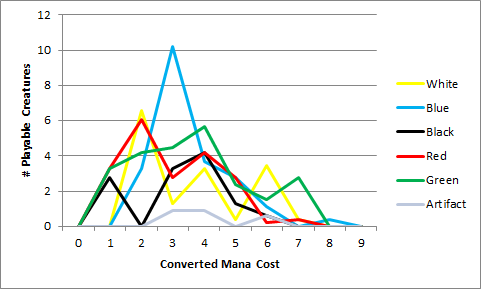
The charts below show the converted mana costs (CMCs) of playable creatures and spells, respectively, by color. (Raise the Alarm, Triplicate Spirits, and Feral Incarnation are counted as creatures rather than spells.) Playable spells are those that I’ve previously evaluated as bombs, exceptional, or good; some of those evaluations have been updated after analysis in subsequent posts. The y-axis of the chart shows the expected number of playables of that color and CMC in an 8-person draft, and weights commons, uncommons, rares, and mythics by the expected number of copies of each in a draft. The charts don’t account for convoke, so white and green spells will appear more expensive than they are in practice.
 |
 |
There are 3 things I want to examine.
August 12, 2014 Leave a comment
Magic 2015 has a plethora of ways to return permanents, especially creatures, to your hand. Some of these, such as Into the Void, can be used on opponents’ creatures and so are always playable if you’re in the color. Others, such as Peel from Reality and Quickling, are instant speed and so are usually playable even if you don’t have particularly cheap creatures or creatures with enters-the-battlefield (ETB) triggers. However, cards such as Invasive Species and Roaring Primadox usually need to be in a deck with multiple ETB triggers in order to shine, so let’s take a look at what Magic 2015 has to offer in that department.
The list below has all the permanents in Magic 2015 that have ETB triggers, sorted by color and rarity. I’ve bolded the common/uncommon creatures that we really want to recur, or that provide a reasonable benefit when we recur other creatures. Italics mean that this permanent has an ETB effect that allows you to reuse creatures.
Looking over this list, it is clear that there are only a small number creatures that we want to replay or that cause us to want to replay other creatures. Most of these creatures are in blue and green, which are also the colors with the most ways to bounce your creatures. Blue has Peel from Reality at common, Quickling at uncommon, and Mercurial Pretender at rare. It also has other cards that let you bounce your own creatures or your opponents’ creatures: Void Snare at common, Into the Void at uncommon, and Jace the Living Guildpact at mythic. Green has Invasive Species at common and Roaring Primadox at uncommon. Of these cards, only Void Snare and Jace the Living Guildpact let you bounce non-creatures, so we do not have a reliable way to reuse ETB effects on those.
Consequently, a creature reuse deck will usually be G/U, and the colors do have enough bounce and ETB effects that the 2 groups of cards can build off each other. The colors also have cheap creatures with ETB effects, so Invasive Species and Roaring Primadox can be played relatively on curve. It is worth noting that Satyr Wayfinder is the only creature in these colors that would be played on turn 1-2 and still have a useful ETB effect, so you should make sure to pick up a few of them if you’re drafting this deck. They can also fix your colors to some extent, so they can give you the option to splash ETB creatures from other colors.
August 5, 2014 Leave a comment
I didn’t have time to write a post this week, but I have a really good excuse:

She’s 7lb 10oz and 55cm long. Both mom and baby are in good health and are recovering well.
 MTGDissected
Recent Comments