KTK: Warriors

W/B Warriors is a popular archetype in Khans of Tarkir draft, but I’ve had a difficult time making it come together on the couple of occasions I’ve tried. Often I’ll take an early Chief of the Scale and hope to pick up an additional Chief (Edge or Scale) and a Raiders’ Spoils, but instead will only see a couple of copies of Rush of Battle. I’ve also had the opposite happen, where I’ve passed an early Raiders’ Spoils when in black, only to get passed another copy later and then a Chief.

First, let’s refer back to the expected frequencies of cards in KTK. An 8-person draft will have an average of 2.4 copies of a given common and 0.9 copies of a given uncommon, so it’s not surprising that I often don’t see the tribal uncommons, especially since they’re all quite playable even outside the archetype. The Chiefs can be played in either Mardu or Abzan and are among the few good 2 drops in the format, and Raiders’ Spoils is decent even if you don’t have many Warriors, especially if you’re playing a token-heavy Mardu deck.

Next, let’s try to determine whether it worth trying to go into the archetype early. Khans of Tarkir has 29 Warriors and another 4 cards that produce Warrior tokens:

  • White: Mardu Hateblade, Mardu Hordechief, Sage-Eye Harrier, Seeker of the Way (uncommon), Take Up Arms (uncommon), Timely Hordemate (uncommon), Herald of Anafenza (rare)
  • Black: Disowned Ancestor, Krumar Bond-Kin, Mardu Skullhunter, Sultai Scavenger, Unyielding Krumar, Bellowing Saddlebrute (uncommon), Bloodsoaked Champion (rare)
  • Red: Mardu Blazebringer (uncommon), War-Name Aspirant (uncommon)
  • Green: Kin-Tree Warden, Woolly Loxodon, Heir of the Wilds (uncommon), Tuskguard Captain (uncommon)
  • Multicolor:
    • W/B: Chief of the Edge (uncommon), Chief of the Scale (uncommon)
    • B/G: Kin-Tree Invocation (uncommon)
    • Abzan: Abzan Guide
    • Mardu: Ponkback Brigade, Mardu Charm (uncommon), Mardu Roughrider (uncommon), Zurgo Helmsmasher (mythic)
    • Temur: Snowhorn Rider, Bear’s Companion (uncommon), Avalanche Tusker (rare), Savage Knuckleblade (rare), Surrak Dragonclaw (mythic)

I usually try to avoid playing marginal cards that are good only if I draw another card in my deck, so I will leave out Sage-Eye Harrier, Take Up Arms, Unyielding Krumar, Mardu Blazebringer, and Kin-Tree Warden from subsequent analysis. Also, Woolly Loxodon is too expensive to benefit from the Warrior tribal cards, and we’re unlikely to be able to use the Chiefs effectively in a Temur deck, so let’s ignore those cards as well.

Applying the expected frequencies, we find that there are an average of 30 Warriors in an 8-person draft: 11 in black, 7 in white, 2 in green, 1 in red, 4 in Mardu, 2 in Abzan, 2 in W/B, and 1 in B/G. This means that W/B has access to 20 playable Warriors, Abzan and Mardu deck have access to 25, and even B/G has access to 14.

However, many of these cards are likely to be of interest to other players in the draft also. If we assume that all players draft a wedge, then monocolored cards are shared by 5 drafters, wedge cards are shared by 1.5 drafters, and enemy-colored cards are shared by 3 drafters (since each enemy color pair appears in 2 wedges). That means we’re likely to end up with only 4 Warriors if we’re in W/B, 3 if we’re in B/G, 6.5 if we’re in Abzan, and 7.5 if we’re in Mardu. These numbers are important because they tell us that if we want to have enough Warriors to justify playing Raiders’ Spoils or Rush of Battle, we usually have to play either Abzan or Mardu, and also need to be willing to play some of the more marginal Warriors.
KTK: List of morph creatures

This is a list of all the morph creatures in the format. The first table has the creature names while the second one has abbreviated descriptions; any portion of the description after a semicolon refers to effects that trigger when the creature is turned face up. Note that the latter table may not accurately represent all attributes of the creature and often leaves out certain details. For instance, it never has information about enters-the-battlefield effects since those are not relevant since face down creature are already in play. Also, I sometimes make mistakes while filling out these tables; please let me know if you spot any issues.

Both tables categorize the creatures by converted mana cost, color, and rarity. Unless specified otherwise, each creature has one colored mana in its morph cost with the rest being generic mana, so a morph creature listed under white/5cc has a morph cost of 4W unless listed otherwise. I also specify morph costs if the creature has X in its morph cost, has a multicolored morph cost, or costs more than the column it is specified in.

Here’s how to interpret the second table:

  • Abbreviations used: A (artifact), attkr (attacker), blkr (blocker), bounce (return permanent to owner’s hand), bury (destroy permanent & it cannot be regenerated), C (creature), CMC (converted mana cost), counter when used as a verb (counter a spell), dmg (damage), draw X (draw X cards), E (enchantment), ETB (enters the battlefield), flyer (creature with flying), freeze X (tap X and it doesn’t untap next turn), gain X (gain X life), GY (graveyard), I (instant), L (land), loot X (draw X cards, then discard X cards), lose X (lose X life), opp (opponent), opp’s X (X controlled by opponent), P (player or power, depending on context), prot (protection), PW (planeswalker), raise (return card from your graveyard to your hand), reanimate (return card from the graveyard to the battlefield), redirect X dmg from A to B (next X dmg that would be dealt to A is dealt to B instead), regen (regenerate), S (sorcery), sac (sacrifice), T (toughness), your X (X you control).
  • Effect (+X/+Y, -X/-Y, hexproof, first strike, prot from a color, etc.) last until end of turn unless specified otherwise.
  • Effects can target any legal permanent or player unless otherwise specified, e.g., X dmg without any qualifiers means that the spell does X damage to any creature or player.
  • Spell descriptions sometimes mention other spells as a way to describe their effects, e.g., Jeering Instigator’s unmorph effect is described as “Act of Treason if your turn” to avoid having to write the full description.

M15: Convoke

Magic 2015 has 22 cards with convoke: 7 in green, 6 in white, 4 in black, 2 in red, 1 in blue, and 2 artifacts. Their quality varies considerably from exceptional (Devouring Light) to unplayable (Meditation Puzzle). There are also a few that remain to be evaluated: Seraph of the Masses, Feral Incarnation, and Overwhelm (which I’d initially evaluated, incorrectly, as a bomb). The quality of these cards depends largely on the number and quality of token producers in the set.

Magic 2015 has 17 cards that produce tokens. While the quality of these cards appears to be quite high at first glance (2 bombs, 7 exceptional, 4 good, 3 TBD, and only 1 unplayable), the expensive ones are less likely to be helpful in powering out expensive convoke spells early. Let’s just look at the ones that cost 4 mana or less:

  • 2cc: Raise the Alarm (excellent), Waste Not (unplayable since Black Cat and Mind Rot are the only non-rare ways to make your opponent discard cards), Spirit Bonds (rare), Necromancer’s Stockpile (generating a token requires discarding a creature, so you don’t actually have more creatures in play, at least in the short term)
  • 3cc: Coral Barrier (good), Hornet Nest (rare, and tokens are only produced when the creature dies), Chasm Skulker (rare, and tokens are only produced when the creature dies), Goblin Rabblemaster (rare)
  • 4cc: Brood Keeper (high setup cost), First Response (high setup cost)

Surprisingly, there are only 2 non-rare cards that produce tokens, cost 4cc or less, and don’t have a high setup cost: Raise the Alarm and Coral Barrier. The first card on the list confirms an intuition I’ve had for some time now: Raise the Alarm is the key enabler for convoke decks, not just because it enables some of the god draws, but because it’s one of the only cheap ways to get multiple creatures on the table. However, having Coral Barrier be the only other card on the list challenges my preconceived notion that, since 59% of the convoke cards are in green or white, the convoke deck should be G/W.

Reviewing the list of convoke spells, it seems that all the exceptional spells are white or artifact anyway, so perhaps W/U can utilize convoke most effectively, perhaps in the form of a skies deck that uses Raise the Alarm and Coral Barrier to hold down the fort. Military Intelligence is likely to be quite good in a deck with fliers and tokens, and Seraph of the Masses is likely to be an excellent finisher.

Note that this does not mean that Siege Wurm is not good, just that you cannot expect to reliably play it on turn 4, even in a G/W deck. It also means that Overwhelm and Feral Incarnation are likely unplayable given the speed of the format.

M15: Tribal effects

Magic 2015 has 11 cards with tribal effects: Obelisk of Urd, Belligerent Sliver, Constricting Sliver, Diffusion Sliver, Leeching Sliver, Venom Sliver, Sliver Hivelord, Preeminent Captain (Soldiers), Necromancer’s Stockpile (Zombies), Crucible of Fire (Dragons), and Goblin Rabblemaster (Goblins).

The first time I drafted Obelisk of Urd, I had a R/G deck that didn’t have more than 4 of any creature type. I was short on playables so I ended up running it. As might be expected, it never gave more than 1 creature +2/+2 and was underwhelming. The next time I drafted Obelisk of Urd, I had a B/r deck with 11 Zombies and the card was a beating and a half whenever it hit play. It was clear from these experiences that the value of Obelisk of Urd depends heavily on the colors you’re drafting. It was also clear that if Obelisk of Urd gives 2+ creatures in play +2/+2, you’re likely to win the game. Let’s take a look at all the tribes in Magic 2015 to determine which color combinations work best with Obelisk of Urd. While determining that, we will also look at which color combinations work best for the other tribal cards in Magic 2015.

This spreadsheet contains a summary of all the creatures in Magic 2015 (including Raise the Alarm, Triplicate Spirit, and Feral Incarnation). That information is summarized by creature type and rarity, with unplayable and sideboard-only cards excluded. The total column shows the expected number of playable/TBD creatures of that creature type in a typical draft.

Looking at this, there are 8 tribes that are expected to have 8+ representatives in an average 8-person draft:

  • Humans are spread across all 5 colors, but W/U, R/W, and U/R have access to the most number of playable ones: 13.5, 12.6, and 11.1 respectively.
  • Elementals are spread across blue, red, and green. G/U has access to 12.2, U/R has access to 11.9, and R/G has access to 9.9.
  • Warriors are almost entirely in red, which has 8.8 in a typical draft.
  • Goblins are entirely in red, with 11.2 in a typical draft.
  • Soldiers are entirely in white, with 10.2 in a typical draft. Note that while Raise the Alarm doesn’t combo with Preeminent Captain, it combos really well with Obelisk of Urd, allowing you to cast it earlier and turn your 1/1’s into 3/3’s. (Similarly, while there are only an average of 6 Spirits in a typical draft, Obelisk of Urd can be absurd with Triplicate Spirits.)
  • Zombies are entirely in black, with 9.8 in a typical draft.
  • Walls are spread across all 5 colors, and no color combination has more than 6.
  • Cats are spread across white, blue, and black, and no color combination has more than 6.

Given these numbers, it seems that most color combinations can make good use of Obelisk of Urd if you draft it early and know what creature types to start drafting once you’ve drafted it. Red provides access to the most options.

  • White: Soldiers (W/X) or Humans (W/U or R/W)
  • Blue: Humans (W/U or U/R) or Elementals (G/U or U/R), so only U/B doesn’t work
  • Black: Zombies (B/X)
  • Red: Warriors (R/X), Goblins (R/X), Humans (R/W or U/R), or Elementals (U/R or R/G)
  • Green: Elementals (G/U or R/G), so only B/G and G/W don’t work

From this, it appears that Preeminent Captain, Necromancer’s Stockpile, and Goblin Rabblemaster have the potential to be good in their respective colors. On the other hand, there are only 2 Dragons in Magic 2015, both at rare, plus Brood Keeper, so Crucible of Fire is unplayable. Also, the set only has 5 playable/TBD Slivers (I don’t consider Sliver Hivelord playable in most decks), all at uncommon, so an 8-person draft will have an average of 4.5 Slivers. Constricting Sliver, Belligerent Sliver, and Venom Sliver are good on their own, but Diffusion Sliver and Leeching Sliver are unplayable.

M15: Converted mana cost distributions

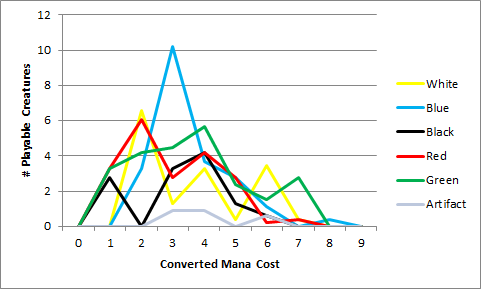
The charts below show the converted mana costs (CMCs) of playable creatures and spells, respectively, by color. (Raise the Alarm, Triplicate Spirits, and Feral Incarnation are counted as creatures rather than spells.) Playable spells are those that I’ve previously evaluated as bombs, exceptional, or good; some of those evaluations have been updated after analysis in subsequent posts. The y-axis of the chart shows the expected number of playables of that color and CMC in an 8-person draft, and weights commons, uncommons, rares, and mythics by the expected number of copies of each in a draft. The charts don’t account for convoke, so white and green spells will appear more expensive than they are in practice.

CMC Distribution - Creatures CMC Distribution - Spells

There are 3 things I want to examine.

  • How many playable 1-2 mana green and blue creatures can we expect to see in a draft? We can combine this information with that from last week’s post to determine how good the various creature reuse spells are. An 8-person draft will, on average, have 3 1-mana (all green) and 7 2-mana creatures (4 green, 3 blue) that fit this bill. Assuming that there are 3 drafters at the table in each color, you can expect to get 1 playable 1-mana creature and 2 playable 2-mana creatures, which is not enough to consistently play Invasive Species on turn 3 or Roaring Primadox on turn 4. Both cards do offer opportunities in the long game by allowing you to recur Frost Lynx, Kapsho Kitefins, Living Totem, Satyr Wayfinder, Shaman of Spring, and Reclamation Sage, but Magic 2015 seems like a fairly fast format so far, and so Invasive Species and Roaring Primadox are probably best relegated to the sideboard and brought in against slower decks where you have to grind out card advantage. Peel from Reality and Quickling are still both excellent, since they can be used at instant speed to save your creatures from removal.
  • Is there a glut of good creatures at 3-mana? I have had a couple of drafts so far that have been heavy on 3-mana creatures, especially when playing black, but am not sure whether that is typical in this format. From the chart on the left, we can see that blue certainly has a plethora of good 3-mana creatures, but this is not true for the other colors. If you are drafting a U/X deck, you might want to pick 3-drops a little less highly. Conversely, black decks should prioritize 2-drops. Looking at (non-creature) spells, we see that red has a large number at 2 mana, as does blue to a lesser extent. Similarly, white has a fair number of spells at 3 mana.
  • Do any color pairs have mana curves that fit together particularly well? White and red both have a fair number of playable 2-drops and fewer 3-drops, while blue and black have fewer 2-drops and more 3-drops. W/R decks in Magic 2015 tend to be aggressive while U/B decks tend to be controlling, so it may seem that these colors don’t fit well together. However, a fast start from a red or white deck backed up by Frost Lynx has the potential to be quite devastating, so it might be worth considering W/U, W/B, U/R, and B/R decks.

M15: G/U creature reuse

Magic 2015 has a plethora of ways to return permanents, especially creatures, to your hand. Some of these, such as Into the Void, can be used on opponents’ creatures and so are always playable if you’re in the color. Others, such as Peel from Reality and Quickling, are instant speed and so are usually playable even if you don’t have particularly cheap creatures or creatures with enters-the-battlefield (ETB) triggers. However, cards such as Invasive Species and Roaring Primadox usually need to be in a deck with multiple ETB triggers in order to shine, so let’s take a look at what Magic 2015 has to offer in that department.

The list below has all the permanents in Magic 2015 that have ETB triggers, sorted by color and rarity. I’ve bolded the common/uncommon creatures that we really want to recur, or that provide a reasonable benefit when we recur other creatures. Italics mean that this permanent has an ETB effect that allows you to reuse creatures.

  • White:
    • commons: Heliod’s Pilgrim (x), Kinsbaile Skirmisher (/, ETB is irrelevant), Midnight Guard (~, ETB is irrelevant), Tireless Missionaries (x)
    • uncommons: Boonweaver Giant (x), Constricting Sliver (B, but it’s only useful to recur Slivers played before Constricting Sliver was played, and the set has very few good Slivers)
    • rares: Resolute Archangel (B), Spirit Bonds (+)
    • non-creatures: Divine Favor (common, x)
  • Blue:
    • commons: Coral Barrier (/, but ETB is rarely relevant), Frost Lynx (/)
    • uncommons: Kapsho Kitefins (+), Quickling (+)
  • Black:
    • commons: Necromancer’s Assistant (~, ETB is useful only in a very specific archetype), Rotfeaster Maggot (S)
    • uncommons: Gravedigger (/)
  • Red:
    • commons: Forge Devil (/), Foundry Street Denizen (~, ETB is irrelevant)
    • rares: Hoarding Dragon (B, ETB is irrelevant since you lose access to the exiled artifact if you bounce Hoarding Dragon), Siege Dragon (B, ETB is rarely relevant)
    • non-creatures: Hammerhand (common)
  • Green:
    • commons: Invasive Species (?), Living Totem (/), Satyr Wayfinder (/), Shaman of Spring (/), Undergrowth Scavenger (?, ETB is irrelevant except perhaps in a B/G self-mill deck)
    • uncommons: Reclamation Sage (+)
    • rares: Genesis Hydra (+), Hornet Queen (B), Kalonian Twingrove (+)
    • non-creatures: Verdant Haven (/, ETB is irrelevant)
  • Artifact/Land (all non-creatures):
    • commons: Radiant Fountain (S)
    • uncommons: Meteorite (~), Staffs of the X Magus (x)
    • rares: Obelisk of Urd (?, ETB is rarely relevant), Phyrexian Revoker (~, ETB is rarely relevant)

Looking over this list, it is clear that there are only a small number creatures that we want to replay or that cause us to want to replay other creatures. Most of these creatures are in blue and green, which are also the colors with the most ways to bounce your creatures. Blue has Peel from Reality at common, Quickling at uncommon, and Mercurial Pretender at rare. It also has other cards that let you bounce your own creatures or your opponents’ creatures: Void Snare at common, Into the Void at uncommon, and Jace the Living Guildpact at mythic. Green has Invasive Species at common and Roaring Primadox at uncommon. Of these cards, only Void Snare and Jace the Living Guildpact let you bounce non-creatures, so we do not have a reliable way to reuse ETB effects on those.

Consequently, a creature reuse deck will usually be G/U, and the colors do have enough bounce and ETB effects that the 2 groups of cards can build off each other. The colors also have cheap creatures with ETB effects, so Invasive Species and Roaring Primadox can be played relatively on curve. It is worth noting that Satyr Wayfinder is the only creature in these colors that would be played on turn 1-2 and still have a useful ETB effect, so you should make sure to pick up a few of them if you’re drafting this deck. They can also fix your colors to some extent, so they can give you the option to splash ETB creatures from other colors.

M15: Typical power/toughness of creatures

In order to determine how good a given creature is, as well as how effective a removal spell is, we need to know the typical power and toughness of creatures in the format. This spreadsheet uses the Must Kill breakdown from my initial set evaluation along with the expected number of cards at each rarity level to determine how likely a creature is to have a given power and toughness, and how likely that creature is one that you really have to get off the battlefield. As mentioned in that post, the Must Kill classification does not automatically include large creatures with flying (or other forms of evasion) since you can neutralize them if you have a large flier or spider.

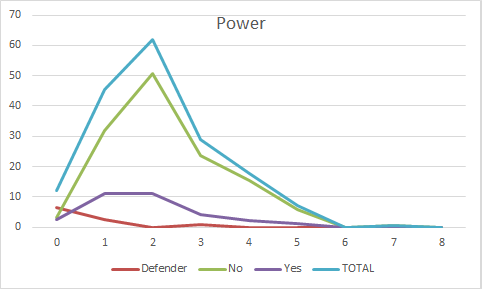
It appears that the typical creature you will encounter in M15 has 2 power and 1 toughness, which means the format is likely to be aggressive. Must Kill creatures most commonly have a toughness of 2. (Yes/No in the charts below refer to whether the creature was classified as Must Kill.)

Magic 2015 Creatures Power Magic 2015 Creatures Toughness

Here are the percentage of creatures with power/toughness less than a given number.

N % Creatures with Power <= N % Creatures with Toughness <= N
0 7% 2%
1 33% 32%
2 69% 59%
3 86% 84%
4 96% 91%
5 100% 98%

And here are the percentage of Must Kill creatures with power/toughness less than a given number.

N % Must Kill Creatures with Power <= N % Must Kill Creatures with Toughness <= N
0 7% 7%
1 42% 23%
2 76% 65%
3 89% 89%
4 96% 94%
5 100% 95%

Removal that kills 1-toughness creatures can kill a quarter of the Must Kill creatures and a third of all the creatures in the set, so it is more useful than in other formats, and perhaps even maindeckable. (I will explore this in more depth in a future post once we have evaluated most of the creatures whose quality is TBD.) Removal that kills 2-toughness creatures can kill about two-thirds of all creatures in the format, Must Kill or otherwise, and so is definitely maindeckable. Removal that kills 3-toughness creatures hits about 90% of the creatures in the format.

THS: Combat damage triggers

I drafted a fairly weak W/U deck last week. It had a couple of heroic creatures, 3 Fate Foretold*, and 2 Thassa’s Emissary. Once I picked up the second Emissary, I started keeping an eye out for cards that could grant them evasion. I drafted a Nimbus Naiad, took a Sea God’s Revenge over an Aqueous Form, and then didn’t see any other cards that would have allowed the Emissaries to get through.

Theros also has several other cards that have combat damage triggers, such as Daxos of Meletis (which I’ve been passed multiple times previously, but unfortunately not this time). In order to better understand how likely it is that I can make these abilities trigger, I decided to make a spreadsheet of all the cards in Theros with such triggers, all the cards that grant evasion, and also all the cards that have evasion (since Bident of Thassa and Warriors’ Lesson let you draw a card if any creatures get through), sorted by color and rarity. Here are some notes on interpreting this spreadsheet:

  • In the Combat Damage Triggers column, italics mean the card doesn’t actually have a combat damage trigger, but has the potential to do a lot of damage if it get through, usually due to Firebreathing or double strike. I have not listed creatures with monstrous, mostly because they’re too many of them and they would dominate the list. Yellow highlight means that the effect can trigger multiple times if 2+ creatures get through.
  • In the Grants Evasion column (which also includes cards that prevent an opponent’s creature(s) from blocking), italics mean that the card grants evasion as a one-time effect. This includes cards like Arena Athlete that can be triggered multiple times, but require a spell to target them for each use. Yellow highlight means that the effect grants evasion to 2+ creature.
  • In the Has Evasion column, italics mean that the creature has a form of evasion other than flying, e.g., intimidate. I have not listed effects that grant trample because it is not a reliable way to trigger these abilities. Yellow highlight means the card gives you 2+ creature with evasion.
  • Red text means that the card appears in more than one column, e.g., Nimbus Naiad has evasion but can also grant evasion to other creatures if played as an Aura.

From the spreadsheet, we can see that blue has the most cards with combat damage triggers: Thassa’s Emissary (uncommon) and Bident of Thassa (rare), as well as the multicolor cards Daxos of Meletis (W/U rare) and Medomai the Ageless (W/U mythic). Red has most of the italicized cards in this column: Dragon Mantle (common), Two-Headed Cerberus (common), and Firedrinker Satyr (rare), as well as the multicolor cards Akroan Hoplite (R/W uncommon) and Polis Crusher (R/G rare with an actual combat damage trigger).

Looking at the next column, white has 2 cards that grant evasion permanently + 1 that grants evasion temporarily (sort of; it only taps one creature). Blue has 3 + 1, black has 0 + 1, red has 1 + 2, green and multicolor have none, and there are 2 + 0 artifacts that grant evasion**. So blue also has the most number of ways to give creatures evasion.

Finally, white has 3 commons + 1 uncommon + 1 rare with evasion (8.7 in an average 8-person draft), blue has 4 + 1 + 1 (11.1), black has 2 + 1 + 1 (6.3), red has 1 uncommon and 1 mythic (1.4), green has 1 common (2.4), and there are 0 + 4 + 1 + 3 (5.8) multicolor cards with evasion and 1 uncommon artifact. Once again, blue leads the pack, but it followed very closely by white.

If you are trying to build around some cards with combat damage triggers but aren’t able to draft a monoblue deck, what is the best color to pair it with? Red seems like it would go well in this deck since it provides a few ways to give creatures evasion, multiple removal spells that allow creatures to get through, as well some creatures that can get through for a lot of damage if unblocked. In particular, Nimbus Naiad on a Two-Headed Cerberus can make short work of an opponent. And you can splash green for Warriors’ Lesson, Polis Crusher, Horizon Chimera, and perhaps Agent of Horizons.

The other possibility is W/U, either a flyers deck or a heroic deck. Since the deck runs several creatures with evasion anyway and has ways to give more creatures evasion, killing your opponent with flyers is a great plan B (or even plan A) for this deck. A heroic deck also has potential since some of the effects that grant evasion also trigger heroic. White also gives you access to Daxos of Meletis and has Gods Willing to protect your creatures once they have been given evasion or a combat damage trigger. As above, you can also splash green for Warriors’ Lesson, Horizon Chimera, and perhaps Agent of Horizons.

* This was my first time playing Fate Foretold and I was not impressed. However, that may have been because I only had a couple of heroic creatures and/or because I played against a lot of blue decks with bounce + Griptides.

** Note that Theros has only 1 Wall, so Prowler’s Helm essentially makes your creature unblockable. It’s very similar to Fleetfeather Sandals, except that it gives up haste in exchange for a near guarantee that the creature will be unblockable.

THS: Follow-up on Minotaurs

I managed to pull off a Minotaurs deck in a recent draft. I was already in red and was passed a Kragma Warcaller pack 1, pick 4 (the other good card in that pack was Wingsteed Rider). I committed myself to a Minotaurs deck shortly thereafter and was rewarded with another Kragma Warcaller in pack 3. My deck also had 6 other Minotaurs: 3 Fellhide Minotaur, 2 Minotaur Skullcleaver, and 1 Borderland Minotaur.

The supporting cast included some aggressive early drops (Tormented Hero, Firedrinker Satyr, Akroan Crusader, Arena Athlete, Blood-Toll Harpy), some removal (2 Lightning Strike, 2 Ordeal of Purphoros, 2 Lash of the Whip), and some finishers (Portent of Betrayal, Ember Swallower, Cavern Lampad). The pair of Kragma Warcallers were the lynchpins of the deck and even led to a U/G opponent scooping immediately when the second one hit the table (he had no way to deal with them permanently).

The main thing the deck lacked was 2-drops. In particular, I would have loved to pick up a couple of Deathbellow Raiders, but I never saw one. Also, Fanatic of Mogis would have been a great finisher for this deck, but I managed to go undefeated even without it.

THS: Chronicler of Heroes

In a recent draft, I took 2 Chroniclers of Heroes early in pack 1, thinking I’d be able to build around them and that they would still be servicable as 3/3’s for 3 mana even if I weren’t able to draft creatures with +1/+1 counters. However, I don’t recall seeing many creatures with +1/+1 counters in that draft, and the ones I did see were rather expensive, making it unlikely that I would be able to play Chronicler of Heroes early and draw a card off it. Does Theros have enough early creatures with +1/+1 counters that there’s a reasonable chance of playing Chronicler of Heroes early and still drawing a card off it? Let’s find out.

Theros has 31 cards that can cause themselves or a creature to get +1/+1 counters. They can be broken down into 4 categories:

  • 16 creatures with monstrosity, concentrated in red and green: Hundred-Handed One (white rare), Sealock Monster (blue uncommon), Shipbreaker Kraken (blue rare), Hythonia the Cruel (black mythic), Keepsake Gorgon (black uncommon), Ember Swallower (red rare), Ill-Tempered Cyclops (red common), Stoneshock Giant (red uncommon), Stormbreath Dragon (red mythic), Arbor Colossus (green rare), Nemesis of Mortals (green uncommon), Nessian Asp (green common), Polukranos World Eater (green mythic), Fleecemane Lion (G/W rare), Polis Crusher (R/G rare), and Colossus of Akros (rare artifact).
  • 7 creatures whose heroic triggers add +1/+1 counters, largely in white and green: Fabled Hero (white rare), Favored Hoplite (white uncommon), Phalanx Leader (white uncommon), Wingsteed Rider (white common), Centaur Battlemaster (green uncommon), Staunch-Hearted Warrior (green common), and Battlewise Hoplite (W/U uncommon).
  • The cycle of Ordeals (commons), 1 in each color.
  • 3 green rares/mythics: Bow of Nylea (rare), Mistcutter Hydra (mythic), and Reverent Hunter (rare).

Looking at these cards, it seems that R/G and G/W are the colors with the most number of creatures with +1/+1 counters, so it seems like I should have been able to make the Chroniclers work. Eliminating the unplayables (the white/green Ordeals and Colossus of Akros), a G/W deck has access to 15 of these cards: 6 of the 16 creatures with monstrosity, 6 of the 7 creatures whose heroic triggers add +1/+1 counters, and all 3 cards in the last category. Of these, 3 are common, 4 are uncommon, 6 are rare, and 2 are mythic.

Now let’s take a look at when green and/or white creatures are likely to have +1/+1 counters so we can determine when Chronicler of Heroes is likely to draw us a card.

  • Commons: Nessian Asp (5 to cast + 7 to add counters), Wingsteed Rider (3 + spell that targets), and Staunch-Hearted Warrior (4 + spell that targets)
  • Uncommons: Nemesis of Mortals (2 to 6 + 2 to 8), Favored Hoplite (1 + spell that targets), Phalanx Leader (2 + spell that targets), and Centaur Battlemaster (5 + spell that targets).
  • Rare: Hundred-Handed One (4 + 6), Arbor Colossus (5 + 6), Fleecemane Lion (2 + 5), Fabled Hero (3 + spell that targets), Bow of Nylea (3 + 2 + creature), and Reverent Hunter (3).
  • Mythic: Polukranos World Eater (4 + 1, or 4 + 5), Mistcutter Hydra (2+, usually at least 4).

Monstrosity costs 5+ to activate (except for Polukranos World Eater and, possibly, Nemesis of Mortals), so those creatures are not going to allow you to draw a card off an early Chronicler. Moreoever, if you have a monstrous creature, it’s likely that you’re already winning the game and that an additional card and a 3/3 body won’t make much difference. Heroic is a better bet since there are commons available at 3 and 4 mana, uncommons at 1, 2, and 5 mana, and a rare at 3 mana, but it still requires you to cast an additional spell to trigger the Heroic effect. The remaining cards are rares and mythics; of these, Reverent Hunter can enable a turn 4 Chronicler that draws a card, and Bow of Nylea can enable the same on turn 5 (you can put the +1/+1 counter on the Chronicler itself if you have 5 mana). If you really need to draw a particular card, Mistcutter Hydra can enable a turn 3 Chronicler that draws a card, although you’ll usually want to wait until you can cast the Hydra as a 3/3 at least.

R/G is not a better option than G/W since it just replaces Hundred-Handed One, Fleecemane Lion, Fabled Hero, Favored Hoplite, Phalanx Leader, and Wingsteed Rider (1 common, 2 uncommons, and 3 rares) with Ember Swallower, Ill-Tempered Cyclops, Stoneshock Giant, Stormbreath Dragon, Polis Crusher, and the red Ordeal (2 commons, 1 uncommon, 2 rares, and 1 mythic). While there is one additional common, many of the red cards are creatures with monstrosity which, as discussed above, are not likely to yield creatures with +1/+1 counters in the early turns of a game. Going R/G also requires you to splash white for Chronicler.

So Chronicler of Heroes can be used in 2 kinds of decks. It can be used in a G/W or R/G/w deck with monstrous creatures, although you’re likely to already be winning the game if you have monstrous creatures in play, and an extra card and a 3/3 body are unlikely to have much impact on the game. Consequently, it is likely to be more effective in a G/W heroic deck.