M15: U/R artifacts

The playability of Aeronaut Tinkerer, Chief Engineer, Ensoul Artifact, Scrapyard Mongrel, and Shrapnel Blast all depend, at least in part, on the number and quality of artifacts in M15. The set has 29 artifacts, including Darksteel Citadel (which I’ve downgraded from good to conditional). Here’s a breakdown by rarity and quality (based on their own merits, not their interactions with other cards in M15).

Quality
Rarity Bomb Excep-
tional
Good Filler/
Conditional
Side-
board
Unplay-
able
TBD TOTAL
Common 2 1 1 4
Uncommon 4 2 1 7 1 15
Rare 2 1 3 1 7
Mythic 1 1 1 3
TOTAL 1 3 5 7 2 9 2 29

Let’s ignore the 9 unplayable and 2 sideboard cards. There are only 2 TBD cards, 1 each at uncommon and rare; they won’t have much impact on the results, so I will ignore them too. That leaves us:

  • Common: 2 filler/conditional cards
  • Uncommon: 4 good and 2 filler/conditional
  • Rare: 2 exceptional, 1 good, and 3 filler/conditional
  • Mythic: 1 bomb and 1 exceptional
    • In an 8-person draft, there will be an average of 0.2 bombs, 1 exceptional card, 4 good cards, and 7.8 filler/conditional cards, for a total of 13 cards. Any player can play an artifact card, so if they are shared evenly, we can only expect to end up with 1.6 on average. However, if we already have some cards that benefit from the presence of artifacts, we can draft artifacts a bit higher. In particular, the filler/conditional cards are likely to come around mid to late pick. Let’s assume that the bomb and exceptional cards are shared evenly among players, that we draft about twice the average share of good cards, and that we draft half the filler cards at the table (the other half might be lost to another player drafting a similar deck, or they might be a better pick in the pack). That would give us 5 artifacts, 4 of which would be filler. Consequently, we would expect to have 1 artifact in our opening hand and draw another one over the course of the game.

      Given that, here’s my evaluation of the cards listed above:

      • Aeronaut Tinkerer (/): It will usually have flying as long as your opponent does not destroy the artifact from your opening hand. Even if they do, you are left with a 2/3 that might regain flying later.
      • Chief Engineer (~): Since we only expect to see 2 artifacts over the course of the game, this will mostly function as a 1/3 blocker.
      • Ensoul Artifact (/): The dream is to play this on turn 2 on a 0/1cc artifact (ideally an Ornithopter) and attack for 5 on turn 2, or play it on a Darksteel Citadel and attack on turn 3 with a 5/5 indestructible creature. However, both those cards are uncommons so a draft will only have about 1 of each, on average. Even if you manage to draft them, there’s no guarantee you’ll start the game with them. Instead, they’re more likely to go on a random artifact and trade for 2 of your opponent’s creatures, resulting in no card advantage. Consequently, this is likely to be better as a late game play on a Darksteel Citadel, Ornithopter, or Gargoyle Sentinel. (Note that Ornithopter is not playable unless you have multiple cards that benefit from artifacts.)
      • Scrapyard Mongrel (/): A 4-mana 3/3 is filler, but this will often be a 5/3 trampler.
      • Shrapnel Blast (/): 5 damage is a lot, but if you have other blue/red cards that benefit from artifacts, then you won’t want to sacrifice your artifact unless you’re killing a particularly troublesome creature or your opponent.
        • Aeronaut Tinkerer and Scrapyard Mongrel are both commons, and ones that other blue and/or red players probably won’t value highly, so U/R artifacts is probably a reasonable archetype in M15 draft.
M15: Typical power/toughness of creatures

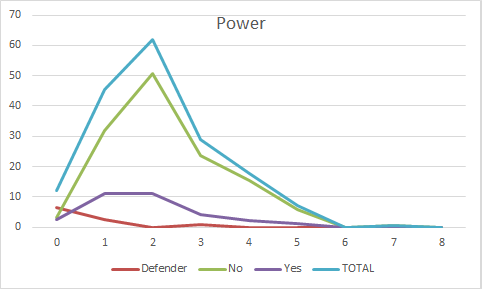
In order to determine how good a given creature is, as well as how effective a removal spell is, we need to know the typical power and toughness of creatures in the format. This spreadsheet uses the Must Kill breakdown from my initial set evaluation along with the expected number of cards at each rarity level to determine how likely a creature is to have a given power and toughness, and how likely that creature is one that you really have to get off the battlefield. As mentioned in that post, the Must Kill classification does not automatically include large creatures with flying (or other forms of evasion) since you can neutralize them if you have a large flier or spider.

It appears that the typical creature you will encounter in M15 has 2 power and 1 toughness, which means the format is likely to be aggressive. Must Kill creatures most commonly have a toughness of 2. (Yes/No in the charts below refer to whether the creature was classified as Must Kill.)

Magic 2015 Creatures Power Magic 2015 Creatures Toughness

Here are the percentage of creatures with power/toughness less than a given number.

N % Creatures with Power <= N % Creatures with Toughness <= N
0 7% 2%
1 33% 32%
2 69% 59%
3 86% 84%
4 96% 91%
5 100% 98%

And here are the percentage of Must Kill creatures with power/toughness less than a given number.

N % Must Kill Creatures with Power <= N % Must Kill Creatures with Toughness <= N
0 7% 7%
1 42% 23%
2 76% 65%
3 89% 89%
4 96% 94%
5 100% 95%

Removal that kills 1-toughness creatures can kill a quarter of the Must Kill creatures and a third of all the creatures in the set, so it is more useful than in other formats, and perhaps even maindeckable. (I will explore this in more depth in a future post once we have evaluated most of the creatures whose quality is TBD.) Removal that kills 2-toughness creatures can kill about two-thirds of all creatures in the format, Must Kill or otherwise, and so is definitely maindeckable. Removal that kills 3-toughness creatures hits about 90% of the creatures in the format.

M15: Expected numbers of copies of a card

Magic 2015 has 249 cards: 101 commons, 80 uncommons, 53 rares, and 15 mythics. This means that an 8-person M15/M15/M15 draft will have an average of 2.4 copies of a given common, 0.9 copies of a given uncommon, 0.4 copies of a given rare, and 0.2 copies of a given mythic.

Note that this rarity distribution is different than that of Magic 2010 through Magic 2014, all of which had 60 uncommons and so had an average of 1.2 copies of a given uncommon in an 8-person draft of that set. This difference will need to be accounted for when deciding on the viability of archetypes that require specific uncommons.

M15: Evaluations

This is an initial set of evaluations of the cards in Magic 2015. Here’re what my various evaluations mean:

  • Bomb (B): Will usually win the game if not dealt with and also difficult to deal with or play around, e.g., large flyers or mass removal.
  • Exceptional (+): A superior card that will turn the tide in your favor, e.g., most unconditional removal that isn’t overcosted or a 3/3 flyer for 4 mana.
  • Good (/): The bread and butter of most decks, e.g., a 2/2 flyer or a vanilla 3/3 for 3 mana.
  • Situational/Filler (~): Good in the right deck, filler in most others, e.g., a vanilla 2/1 in a deck that is not particularly aggressive.
  • Sideboard (S): Useful to have in your sideboard, but not usually playable maindeck, e.g., artifact/enchantment destruction or color hosers that aren’t good if you’re not playing against those colors.
  • Unplayable (x): Should not be played except in the right deck or under exceptional circumstances, e.g., a vanilla 1/1 for 1 mana. Some unplayable creatures can be sided in against the right deck, e.g., a vanilla 1/3 for 3 mana might still be sided in against an aggressive deck.
  • TBD (?): Requires more analysis or more experience with the format to evaluate, e.g., a card that depends on how many playable enchantments there are in the format.

The spreadsheet also has explanations for many of my evaluations. Here are some evaluations worth noting:

  • Raise the Alarm (/), Coral Barrier (/): especially good with convoke
  • Inferno Fist (/): especially good with first strike
  • Ranger’s Guile (~): good, but Gather Courage and Titanic Growth are better
  • Grindclock (~): earliest win is turn 11, if played on turn 2 and set to 5-9 counters, so only good in a very controlling deck or a dedicated mill deck</li

Here are the cards that need additional analysis to fully evaluate, and what the evaluation will depend on. This will guide subsequent analysis.

  • Aeronaut Tinkerer, Chief Engineer, Ensoul Artifact, Scrapyard Mongrel, Shrapnel Blast, Torch Fiend: #/quality of artifacts
  • Kurkesh Onakke Ancient: #/quality of activated abilities on artifacts
  • Phyrexian Revoker (~): #/quality of activated abilities
  • Hushwing Gryff (/), Peel from Reality (/), Quickling (+), Invasive Species, Roaring Primadox: #/quality of ETB effects
  • Mind Sculpt, Undergrowth Scavenger, Grindclock (~), Profane Memento: #/quality of mill effects
  • Seraph of the Masses, Military Intelligence, Feral Incarnation: #/quality of token producers
  • Boonweaver Giant (x), Sungrace Pegasus, Brood Keeper: #/quality of enhancing Auras
  • Midnight Guard (~): #/quality of Auras/Equipment conferring tap abilities
  • Act on Impulse, Aggressive Mining, Rummaging Goblin: distribution of red CMCs
  • Selfless Cathar: how aggressive W/X decks are
  • Ajani’s Pridemate, Wall of Limbs: #/quality of lifegain
  • Obelisk of Urd: #/quality of tribes
  • Diffusion Sliver, Leeching Sliver, Belligerent Sliver: #/quality of Slivers
  • Preeminent Captain: #/quality of Soldiers
  • Necromancer’s Stockpile (/): #/quality of Zombies
  • Goblin Rabblemaster (+): #/quality of Goblin
  • Crucible of Fire (x): #/quality of Dragons
  • Clear a Path (S): #/quality of defenders
  • Warden of the Beyond: #/quality of effects that exile cards
  • Waste Not: #/quality of discard effects
  • Crippling Blight (~): #/quality of 1-toughness creature

M15: Compact FAQ

This is a compact version of the Magic 2015 FAQ (14 pages vs. 34 pages for the original).

M15: List of instant-speed tricks

This is a list of all the instant-speed tricks in the format. The first table has the spell names while the second one has abbreviated spell descriptions in case you don’t remember what the spell does. Note that the latter table may not accurately represent all uses of the spell and often leaves out certain details. Also, I sometimes make mistakes while filling out these tables; please let me know if you spot any issues.

Both tables categorize the tricks by converted mana cost, color, and rarity. Unless specified otherwise, each colored spell has one colored mana in its mana cost with the rest being generic mana, so a 3-mana white spell with no explicit cost has a mana cost of 2W. I also specify mana costs if the spell has X in its mana cost, is multicolored, or costs more than the column it is specified in. Spells in bold can leave a creature in play, e.g., flash creatures, spells that create token creatures, or spells that allow you to cast creatures at instant speed.

Here’s how to interpret the second table:

  • Abbreviations used: A (artifact), attkr (attacker), blkr (blocker), bounce (return permanent to owner’s hand), bury (destroy permanent & it cannot be regenerated), C (creature), CMC (converted mana cost), counter when used as a verb (counter a spell), dmg (damage), draw X (draw X cards), E (enchantment), ETB (enters the battlefield), flyer (creature with flying), freeze X (tap X and it doesn’t untap next turn), gain X (gain X life), GY (graveyard), I (instant), L (land), loot X (draw X cards, then discard X cards), lose X (lose X life), opp (opponent), opp’s X (X controlled by opponent), P (player or power, depending on context), prot (protection), PW (planeswalker), raise (return card from your graveyard to your hand), reanimate (return card from the graveyard to the battlefield), redirect X dmg from A to B (next X dmg that would be dealt to A is dealt to B instead), regen (regenerate), S (sorcery), sac (sacrifice), T (toughness), your X (X you control).
  • Spells that confer an effect (+X/+Y, -X/-Y, hexproof, first strike, prot from a color, etc.) last until end of turn unless specified otherwise.
  • Spells can target any legal permanent or player unless otherwise specified, e.g., X dmg without any qualifiers means that the spell does X damage to any creature or player.
  • Spell descriptions sometimes mention other spells as a way to describe their effects, e.g., Hunter’s Ambush is described as Fog all nongreen Cs to avoid having to write the full description.

M15: Compact spoiler

This is an 8-page version of the full Magic 2015 spoiler. The card image gallery at DailyMTG is 51 pages so I’m hoping this saves trees, and it’s certainly easier to carry around in your pocket.

Note: There are 15 additional cards (all reprints) in Magic 2015 that don’t appear in booster packs, only in sample decks and the Deck Builder’s Toolkit. Since this blog is about Limited, the compact spoiler does not list these cards.

JOU/BNG/THS: Followup on the mill deck

Last week, I’d hypothesized that mill decks in Theros block draft should be U/B, or perhaps U/W. I then proceeded to draft a mill deck that was actually U/G, like the mill decks in Magic 2014. I suspect this color combination is unusual for mill decks in this format; it came together primarily because I opened an Eidolon of Blossoms in my first pack, then took a Bassara Tower Archer (over a Thassa’s Devourer), a Golden Hind, and a Thassa’s Devourer hoping that the first one would lap the table (it did). In Born of the Gods, I picked up a pair of Evanescent Intellects, and then focused on rounding out the deck in the Theros pack. Here’s the deck I played:

Creatures Spells/Land Sideboard
Sedge Scorpion
Bassara Tower Archer
Golden Hind
Triton Fortune Hunter
War-Wing Siren
Nyxborn Triton
Nyxborn Wolf
Nylea’s Disciple
Cloaked Siren
Eidolon of Blossoms
Prescient Chimera
2 Thassa’s Devourer
Archetype of Endurance
2 Evanescent Intellect
Triton Tactics
Savage Surge
Ordeal of Nylea
Pin to the Earth
Kruphix’s Insight
Eternity Snare
Interpret the Signs

Temple of Plenty
8 Forests
8 Islands

Guardians of Meletis
Pillar of War
Hunt the Hunter
Defend the Hearth
Unravel the Aether
Fade into Antiquity
Aerial Formation
Lost in a Labyrinth
2 Stratus Walk
Pull from the Deep
Ephara’s Enlightenment
Leonin Iconoclast
Ephara’s Radiance
Font of Vigor
Glare of Heresy
Ray of Dissolution
Claim of Erebos

There were several tough cuts from the final build:

  • I really wanted to run the pair of Stratus Walks for the constellation/heroic triggers they offered and the interaction with Kruphix’s Insight, as well as the cantrip effect. However, I decided to run Prescient Chimera and Cloaked Siren instead, even though my deck only has 2 sorceries, 2 instants, no other flash creatures, and 2 instant-speed activated abilities. This is because I really didn’t want to go down to 12 creatures while running 5 Auras, 2 bestow effects, and 2 combat tricks. I also wanted to ensure I had enough aerial defense since this deck can take a while to get set up. (I should probably have prioritized Shredding Winds when drafting this deck, since it is fairly short on removal.)
  • Ephara’s Enlightenment combos well with my constellation creatures, but I would have had to run at least 2 Plains in addition to the Temple of Plenty, and I didn’t want to mess up my mana base. If I’d seen any other color fixing, I would have happily picked it up and run Ephara’s Enlightenment and Leonin Iconoclast.
  • Guardians of Meletis and Pillar of War would have fit the deck’s goal, but I had enough ground defense and enough 3cc creatures. I also didn’t want to expose myself to incidental artifact removal such as Reckless Reveler and Wild Celebrants since I wasn’t running any other artifacts.
  • Fade into Antiquity and Unravel the Aether would have provided my deck some much needed removal, but I couldn’t afford to run potentially dead cards.

The deck ended up going 1-2, but both the matches I lost were quite close, and I felt like things could have turned out differently if I’d had fewer mulligans or if my opponent has slightly slower starts. A particularly disappointing loss was to a B/G graveyard deck whose pilot was aiding me by milling his own library. However, I did win a game against him by playing Sedge Scorpion on turn 1 and Ordeal of Nylea on turn 2, and swinging for the fences.

JOU/BNG/THS: The mill deck

Theros and Born of the Gods had a smattering of mill cards, but no particularly effective ones at common or uncommon other than Evanescent Intellect, which gave your opponent an opportunity to 2-for-1 you. Journey into Nyx brings Thassa’s Devourer and Countermand to the table. Does this give us a critical mass of mill cards in a block draft?

Let’s start by looking at all the cards in the format that help you get cards out of your opponent’s library, organized by set, rarity, and color. The number after the color indicates how many cards it mills. N / X means it is a reusable effect that mills N cards each time X occurs, whether that be a mana cost or an ability trigger.

Journey into Nyx Born of the Gods Theros
Common Countermand (blue, 4) Evanescent Intellect (blue, 3 / 1U+{T}) Thassa’s Bounty (blue, 3)
Thassa’s Devourer (blue, 2 / constellation) Forsaken Drifters (black, 4) Returned Centaur (black, 4)
Returned Reveler (black, 3)
Uncommon Dakra Mystic (blue, 1 / U+{T}) Siren of the Silent Song (U/B, 1 / inspired)
Rare Mindreaver (blue, 3 / heroic) Pyxis of Pandemonium (artifact, 1 / {T})
Daxos of Meletis (W/U, 1 / dealing combat dmg to opp)
Mythic Phenax, God of Deception (U/B, T / creature) Ashiok, Nightmare Weaver (U/B, 3 / turn)

Thassa’s Devourer is the strongest of the mill effects at common since it has a reusable effect with a reasonable trigger condition, and provides a strong defence that buys you time to mill out your opponent. None of the other common or uncommon mill effects in Journey into Nyx are worth building a deck around, and an 8-person draft will only have 1.3 copies of Thassa’s Devourer, so a mill deck is only possible in a draft with an unsually high number of copies of the card or in a casual draft with more than 8 people. If you’re already in blue and see a couple of copies going around, you can plan to take them if they lap the table. (If someone else takes them, you don’t want to be drafting a mill deck anyway, since the format does not have enough mill cards to support 2 drafters.) If you don’t end up drafting a mill deck, they can still be a good sideboard plan against control decks. Since you have to draw at least 1 Thassa’s Devourer for the deck to get going, you’re not likely to have a strong mill deck unless you draft at least 3+ copies of the card, especially since the format has a fair bit of enchantment removal.

Once you have decided to draft a mill deck, it is probably worth picking up Evanescent Intellect in Born of the Gods. While playing it still involves a certain amount of risk, I believe Journey into Nyx makes the card more playable since it triggers Thassa’s Devourer (and so can mill 5 cards on the turn it comes into play) and Countermand can protect the enchanted creature from removal. Like Thassa’s Devourer, Evanescent Intellect is likely to lap the table, so you don’t need to take them the first time around.

If you’re building towards a mill deck but are not yet in black when you get to Born of the Gods, you can also consider white as your second color. The color provides Dawn to Dusk and Griffin Dreamfinder as ways to get Thassa’s Devourer back if it is killed. It also provides access to Daxos of Meletis and Gods Willing in the Theros pack, although those are not passed quite as often as Returned Centaur. If you’re drafting this deck, you should also prioritize Griptide higher since it allows you to mill away your opponent’s best creature after putting it back on top of their library.

JOU: Pheres-Band Warchief

How good is Pheres-Band Warchief in Theros block draft, and how early should you pick him? I’ll start by pointing out that even if you draft a Pheres-Band Warchief, you should not try to draft around it, since you may never draw the card. And it’s a rare, so you’re unlikely to get passed another copy (although I have seen that happen). Consequently, while you might pick centaurs slightly higher than you might otherwise once you draft a Pheres-Band Warchief, you should still only draft those that are playable on their own merits. (Journey into Nyx only has 2 common centaurs, so it would be difficult to commit to a centaurs deck even if you have multiple copies of Pheres-Band Warchief.)

Let’s look at the centaurs in the format, organized by color and set, along with information about their quality, rarity, and how many playable ones you can expect to see on average in an 8-person draft:

Journey into Nyx Born of the Gods Theros
White Lagonna-Band Trailblazer (good) Lagonna-Band Elder (good)
Black Returned Centaur (unplayable)
Green Pheres-Band Thunderhoof (good), Pheres-Band Warchief (TBD, rare) Swordwise Centaur (good), Pheres-Band Tromper (good), Pheres-Band Raiders (filler, uncommon), Courser of Kruphix (bomb, rare) Nessian Courser (good), Nylea’s Disciple (good), Pheres-Band Centaurs (unplayable), Centaur Battlemaster (good, uncommon)
Multicolor Fanatic of Xenagos (uncommon) Chronicler of Heroes (good, uncommon)
TOTAL (good+) 2.8 3.2 3.2

Most of the centaurs in Theros block are green, with a couple in white, a couple more that are multicolor, as well as an unplayable one in black. Most of them are playable on their own merits, and an 8-person draft will have about 9 playable ones on average. However, the green centaurs are good in B/G control, and Lagonna-Band Trailblazer is excellent in W/U heroic, so you will have to compete with other players for them. You probably can’t expect to get more than 3-5 of them, unless you prioritize them exceptionally high, or unless green is completely open at the table.

Given that, Pheres-Band Warchief should just be drafted on it’s own merits since you’re unlikely to be able to draft a large number of centaurs to go with it. A 3/3 with vigilance and trample for 3G is quite good, but probably shouldn’t be picked above a decent removal spell.