M15: U/R artifacts

The playability of Aeronaut Tinkerer, Chief Engineer, Ensoul Artifact, Scrapyard Mongrel, and Shrapnel Blast all depend, at least in part, on the number and quality of artifacts in M15. The set has 29 artifacts, including Darksteel Citadel (which I’ve downgraded from good to conditional). Here’s a breakdown by rarity and quality (based on their own merits, not their interactions with other cards in M15).

Quality
Rarity Bomb Excep-
tional
Good Filler/
Conditional
Side-
board
Unplay-
able
TBD TOTAL
Common 2 1 1 4
Uncommon 4 2 1 7 1 15
Rare 2 1 3 1 7
Mythic 1 1 1 3
TOTAL 1 3 5 7 2 9 2 29

Let’s ignore the 9 unplayable and 2 sideboard cards. There are only 2 TBD cards, 1 each at uncommon and rare; they won’t have much impact on the results, so I will ignore them too. That leaves us:

  • Common: 2 filler/conditional cards
  • Uncommon: 4 good and 2 filler/conditional
  • Rare: 2 exceptional, 1 good, and 3 filler/conditional
  • Mythic: 1 bomb and 1 exceptional
    • In an 8-person draft, there will be an average of 0.2 bombs, 1 exceptional card, 4 good cards, and 7.8 filler/conditional cards, for a total of 13 cards. Any player can play an artifact card, so if they are shared evenly, we can only expect to end up with 1.6 on average. However, if we already have some cards that benefit from the presence of artifacts, we can draft artifacts a bit higher. In particular, the filler/conditional cards are likely to come around mid to late pick. Let’s assume that the bomb and exceptional cards are shared evenly among players, that we draft about twice the average share of good cards, and that we draft half the filler cards at the table (the other half might be lost to another player drafting a similar deck, or they might be a better pick in the pack). That would give us 5 artifacts, 4 of which would be filler. Consequently, we would expect to have 1 artifact in our opening hand and draw another one over the course of the game.

      Given that, here’s my evaluation of the cards listed above:

      • Aeronaut Tinkerer (/): It will usually have flying as long as your opponent does not destroy the artifact from your opening hand. Even if they do, you are left with a 2/3 that might regain flying later.
      • Chief Engineer (~): Since we only expect to see 2 artifacts over the course of the game, this will mostly function as a 1/3 blocker.
      • Ensoul Artifact (/): The dream is to play this on turn 2 on a 0/1cc artifact (ideally an Ornithopter) and attack for 5 on turn 2, or play it on a Darksteel Citadel and attack on turn 3 with a 5/5 indestructible creature. However, both those cards are uncommons so a draft will only have about 1 of each, on average. Even if you manage to draft them, there’s no guarantee you’ll start the game with them. Instead, they’re more likely to go on a random artifact and trade for 2 of your opponent’s creatures, resulting in no card advantage. Consequently, this is likely to be better as a late game play on a Darksteel Citadel, Ornithopter, or Gargoyle Sentinel. (Note that Ornithopter is not playable unless you have multiple cards that benefit from artifacts.)
      • Scrapyard Mongrel (/): A 4-mana 3/3 is filler, but this will often be a 5/3 trampler.
      • Shrapnel Blast (/): 5 damage is a lot, but if you have other blue/red cards that benefit from artifacts, then you won’t want to sacrifice your artifact unless you’re killing a particularly troublesome creature or your opponent.
        • Aeronaut Tinkerer and Scrapyard Mongrel are both commons, and ones that other blue and/or red players probably won’t value highly, so U/R artifacts is probably a reasonable archetype in M15 draft.
M15: Typical power/toughness of creatures

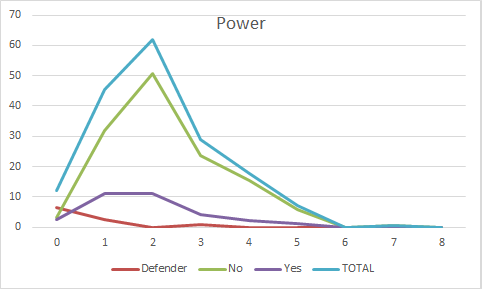
In order to determine how good a given creature is, as well as how effective a removal spell is, we need to know the typical power and toughness of creatures in the format. This spreadsheet uses the Must Kill breakdown from my initial set evaluation along with the expected number of cards at each rarity level to determine how likely a creature is to have a given power and toughness, and how likely that creature is one that you really have to get off the battlefield. As mentioned in that post, the Must Kill classification does not automatically include large creatures with flying (or other forms of evasion) since you can neutralize them if you have a large flier or spider.

It appears that the typical creature you will encounter in M15 has 2 power and 1 toughness, which means the format is likely to be aggressive. Must Kill creatures most commonly have a toughness of 2. (Yes/No in the charts below refer to whether the creature was classified as Must Kill.)

Magic 2015 Creatures Power Magic 2015 Creatures Toughness

Here are the percentage of creatures with power/toughness less than a given number.

N % Creatures with Power <= N % Creatures with Toughness <= N
0 7% 2%
1 33% 32%
2 69% 59%
3 86% 84%
4 96% 91%
5 100% 98%

And here are the percentage of Must Kill creatures with power/toughness less than a given number.

N % Must Kill Creatures with Power <= N % Must Kill Creatures with Toughness <= N
0 7% 7%
1 42% 23%
2 76% 65%
3 89% 89%
4 96% 94%
5 100% 95%

Removal that kills 1-toughness creatures can kill a quarter of the Must Kill creatures and a third of all the creatures in the set, so it is more useful than in other formats, and perhaps even maindeckable. (I will explore this in more depth in a future post once we have evaluated most of the creatures whose quality is TBD.) Removal that kills 2-toughness creatures can kill about two-thirds of all creatures in the format, Must Kill or otherwise, and so is definitely maindeckable. Removal that kills 3-toughness creatures hits about 90% of the creatures in the format.

M15: Expected numbers of copies of a card

Magic 2015 has 249 cards: 101 commons, 80 uncommons, 53 rares, and 15 mythics. This means that an 8-person M15/M15/M15 draft will have an average of 2.4 copies of a given common, 0.9 copies of a given uncommon, 0.4 copies of a given rare, and 0.2 copies of a given mythic.

Note that this rarity distribution is different than that of Magic 2010 through Magic 2014, all of which had 60 uncommons and so had an average of 1.2 copies of a given uncommon in an 8-person draft of that set. This difference will need to be accounted for when deciding on the viability of archetypes that require specific uncommons.

M15: Evaluations

This is an initial set of evaluations of the cards in Magic 2015. Here’re what my various evaluations mean:

  • Bomb (B): Will usually win the game if not dealt with and also difficult to deal with or play around, e.g., large flyers or mass removal.
  • Exceptional (+): A superior card that will turn the tide in your favor, e.g., most unconditional removal that isn’t overcosted or a 3/3 flyer for 4 mana.
  • Good (/): The bread and butter of most decks, e.g., a 2/2 flyer or a vanilla 3/3 for 3 mana.
  • Situational/Filler (~): Good in the right deck, filler in most others, e.g., a vanilla 2/1 in a deck that is not particularly aggressive.
  • Sideboard (S): Useful to have in your sideboard, but not usually playable maindeck, e.g., artifact/enchantment destruction or color hosers that aren’t good if you’re not playing against those colors.
  • Unplayable (x): Should not be played except in the right deck or under exceptional circumstances, e.g., a vanilla 1/1 for 1 mana. Some unplayable creatures can be sided in against the right deck, e.g., a vanilla 1/3 for 3 mana might still be sided in against an aggressive deck.
  • TBD (?): Requires more analysis or more experience with the format to evaluate, e.g., a card that depends on how many playable enchantments there are in the format.

The spreadsheet also has explanations for many of my evaluations. Here are some evaluations worth noting:

  • Raise the Alarm (/), Coral Barrier (/): especially good with convoke
  • Inferno Fist (/): especially good with first strike
  • Ranger’s Guile (~): good, but Gather Courage and Titanic Growth are better
  • Grindclock (~): earliest win is turn 11, if played on turn 2 and set to 5-9 counters, so only good in a very controlling deck or a dedicated mill deck</li

Here are the cards that need additional analysis to fully evaluate, and what the evaluation will depend on. This will guide subsequent analysis.

  • Aeronaut Tinkerer, Chief Engineer, Ensoul Artifact, Scrapyard Mongrel, Shrapnel Blast, Torch Fiend: #/quality of artifacts
  • Kurkesh Onakke Ancient: #/quality of activated abilities on artifacts
  • Phyrexian Revoker (~): #/quality of activated abilities
  • Hushwing Gryff (/), Peel from Reality (/), Quickling (+), Invasive Species, Roaring Primadox: #/quality of ETB effects
  • Mind Sculpt, Undergrowth Scavenger, Grindclock (~), Profane Memento: #/quality of mill effects
  • Seraph of the Masses, Military Intelligence, Feral Incarnation: #/quality of token producers
  • Boonweaver Giant (x), Sungrace Pegasus, Brood Keeper: #/quality of enhancing Auras
  • Midnight Guard (~): #/quality of Auras/Equipment conferring tap abilities
  • Act on Impulse, Aggressive Mining, Rummaging Goblin: distribution of red CMCs
  • Selfless Cathar: how aggressive W/X decks are
  • Ajani’s Pridemate, Wall of Limbs: #/quality of lifegain
  • Obelisk of Urd: #/quality of tribes
  • Diffusion Sliver, Leeching Sliver, Belligerent Sliver: #/quality of Slivers
  • Preeminent Captain: #/quality of Soldiers
  • Necromancer’s Stockpile (/): #/quality of Zombies
  • Goblin Rabblemaster (+): #/quality of Goblin
  • Crucible of Fire (x): #/quality of Dragons
  • Clear a Path (S): #/quality of defenders
  • Warden of the Beyond: #/quality of effects that exile cards
  • Waste Not: #/quality of discard effects
  • Crippling Blight (~): #/quality of 1-toughness creature

M15: Compact FAQ

This is a compact version of the Magic 2015 FAQ (14 pages vs. 34 pages for the original).

M15: List of instant-speed tricks

This is a list of all the instant-speed tricks in the format. The first table has the spell names while the second one has abbreviated spell descriptions in case you don’t remember what the spell does. Note that the latter table may not accurately represent all uses of the spell and often leaves out certain details. Also, I sometimes make mistakes while filling out these tables; please let me know if you spot any issues.

Both tables categorize the tricks by converted mana cost, color, and rarity. Unless specified otherwise, each colored spell has one colored mana in its mana cost with the rest being generic mana, so a 3-mana white spell with no explicit cost has a mana cost of 2W. I also specify mana costs if the spell has X in its mana cost, is multicolored, or costs more than the column it is specified in. Spells in bold can leave a creature in play, e.g., flash creatures, spells that create token creatures, or spells that allow you to cast creatures at instant speed.

Here’s how to interpret the second table:

  • Abbreviations used: A (artifact), attkr (attacker), blkr (blocker), bounce (return permanent to owner’s hand), bury (destroy permanent & it cannot be regenerated), C (creature), CMC (converted mana cost), counter when used as a verb (counter a spell), dmg (damage), draw X (draw X cards), E (enchantment), ETB (enters the battlefield), flyer (creature with flying), freeze X (tap X and it doesn’t untap next turn), gain X (gain X life), GY (graveyard), I (instant), L (land), loot X (draw X cards, then discard X cards), lose X (lose X life), opp (opponent), opp’s X (X controlled by opponent), P (player or power, depending on context), prot (protection), PW (planeswalker), raise (return card from your graveyard to your hand), reanimate (return card from the graveyard to the battlefield), redirect X dmg from A to B (next X dmg that would be dealt to A is dealt to B instead), regen (regenerate), S (sorcery), sac (sacrifice), T (toughness), your X (X you control).
  • Spells that confer an effect (+X/+Y, -X/-Y, hexproof, first strike, prot from a color, etc.) last until end of turn unless specified otherwise.
  • Spells can target any legal permanent or player unless otherwise specified, e.g., X dmg without any qualifiers means that the spell does X damage to any creature or player.
  • Spell descriptions sometimes mention other spells as a way to describe their effects, e.g., Hunter’s Ambush is described as Fog all nongreen Cs to avoid having to write the full description.

M15: Compact spoiler

This is an 8-page version of the full Magic 2015 spoiler. The card image gallery at DailyMTG is 51 pages so I’m hoping this saves trees, and it’s certainly easier to carry around in your pocket.

Note: There are 15 additional cards (all reprints) in Magic 2015 that don’t appear in booster packs, only in sample decks and the Deck Builder’s Toolkit. Since this blog is about Limited, the compact spoiler does not list these cards.

M14: Archetype wheel

Magic 2014 Archetype Wheel

If we take all the archetypes discussed in my last post and plot them on a color wheel, this is what we get. A line between 2 colors indicates that there is an archetype that spans those 2 colors (we’ll ignore the occasional 3- and 5-color decks in M14), and is labeled with the archetype name. A thick line indicates that the archetype that is more likely to come together in a draft because it relies on fewer key cards or requires fewer uncommons/rares; these are the archetypes that were bolded in my last post. Archetypes that rely on specific rares or multiple copies of a common/uncommon in order to function are riskier to attempt and are indicated with thinner lines. If you want to read more about a particular archetype, my last post has a list of the key cards for each archetype and links to more detailed descriptions.

The purpose of the archetype wheel is to help us see visually which colors support the most number of archetypes and, therefore, offer the most flexibility. This can help when choosing between 2 cards of similar power levels in the early stages of a draft. For instance, white and red support the most number of archetypes, so you might take a card in one of those colors slightly higher pack 1, pick 1. White is especially flexible in that it has a likely archetype with each other color. The downside of this is that you’re more likely to be competing with other players for good white cards.

On the other hand, black only pairs well with white, and so offers less flexibility, but you’re also likely to face less competition for good black cards. Also, a good W/B enchantments deck is one of the strongest decks in the format. This does not mean that W/B is the only possible color pair for black, just that it is the only one that offers strong synergies; I have seen good U/B and B/G decks drafted when cards in those colors were flowing.

Note that W/B, U/R, R/G, and R/W each support 2 archetypes, although U/R is the only one that supports 2 archetypes that are likely to come together. While the 2 U/R archetypes are quite different, they both want red burn spells and blue removal/pseudo-removal (Claustrophobia, Time Ebb, Disperse, and Frost Breath), as well as certain uncommons like Young Pyromancer, so it is likely that a table can only support 1 of each. Also, while Slivers can be G/R, G/W, or R/W, an 8-person draft can usually support only 2 Sliver decks.

Let’s look at one more piece of information. This spreadsheet summarizes card quality by color. It shows that white will have the most number of bombs in an average 8-person draft, but also the most number of unplayable cards by far. Black will have the most number of bombs + exceptional cards, and black and green will have the most number of bomb + exceptional + playable cards in a draft. This means that it is more difficult to put together a white deck, since white has fewer playables spread across more archetypes, while it will often be easier to get enough playable black cards since it has more playables spread across fewer archetypes.

Weaving all this information together, we can conclude that a typical draft will likely have:

  • 1 W/U skies deck
  • 2 W/B enchantments decks (which tend to be heavier black), one of which might also have a lifegain subtheme
  • 1 U/R tempo deck
  • 1 U/R control deck
  • 2 Slivers deck: 1 R/G and 1 R/W or G/W
  • Given that there are 4 white decks, 3 blue decks, 2 black decks, 3.5 red decks, and 1.5 green decks, and that black and green also have the most number of playables in the typical draft, the last deck is likely to be B/G or 5-color green

This is the last M14 post I have planned for now, since I’ve run most of the analysis that I’d wanted to. If I missed your favorite archetype, if you’d like me to look at another card more closely, or if you’d like to write a guest post, please email me at sameer underscore (_) merchant at yahoo or leave a comment below.

M14: Summary of archetypes

Here’s a summary of the M14 archetypes we’ve covered, in the order they were discussed. Archetypes in bold require fewer uncommons/rares or have more substitutes, and are therefore more likely to come together in a draft. These archetypes may also be able to support more than one drafter at an 8-person draft. “+” is used to separate different categories of cards required for the archetype. Italics denote cards that are secondary for this archetype and should usually be drafted once you have a number of the non-italicized cards listed. [] indicates that a card is rare or mythic.

  • G/R, G/W, R/W, G/R/W, or 5-color green Slivers: Manaweft Sliver, Predatory Sliver, Battle Sliver, [rare Slivers], Steelform Sliver, [Door of Destinies] + mana fixing if playing 5-color green (Verdant Haven, Shimmering Grotto)
  • G/R Beasts: Beasts (Kalonian Tusker, Rumbling Baloth, Marauding Maulhorn) + Beasts tribal effects (Advocate of the Beast, [Door of Destinies])
  • B/W(/g) lifegain deck: Lifegain-matters cards (Angelic Accord, Sanguine Bond, Voracious Wurm) + lifegain (Mark of the Vampire, Child of Night, Corrupt, Congregate, Bubbling Cauldron, Trading Post, Elixir of Immortality, Brindle Boar)
  • B/W enchantments: Enchantments-matter cards (Blightcaster, [Ajani’s Chosen], Auramancer — if you have Quag Sickness) + enchantments (Quag Sickness, Pacifism, Mark of the Vampire)
  • B/R sacrifice: Act of Treason, Tenacious Dead, [Chandra’s Phoenix], [Dark Prophecy] + sacrifice outlets (Barrage of Expendables, Blood Bairn, Gnawing Zombie, Altar’s Reap, Bubbling Cauldron, Trading Post) + token generators (Young Pyromancer, Molten Birth)
  • U/G mill: [Jace Memory Adept], [Traumatize], [Jace’s Mindseeker], Millstone, Tome Scour + Archaeomancer + stall (Time Ebb, Frost Breath, countermagic + Deadly Spider, Seacoast Drake, Wall of Frost)
  • U/R control: Academy Raider, Archaeomancer + stall (burn, countermagic, Time Ebb, Disperse, Frost Breath) + card advantage (card draw, [Strionic Resonator]) + win conditions
  • U/R tempo: Trained Condor, Goblin Shortcutter + cheap creatures + burn + tempo (Time Ebb, Frost Breath, Disperse) + finishers (Seismic Stomp, Lava Axe). Watch out for Shrivel.
  • W/U skies: Wall of Frost, Seacoast Drake, Angelic Wall + white/blue evasion creatures (especially Warden of Evos Isle, [Seraph of the Sword], [Windreader Sphinx]) + removal (Claustrophobia, Pacifism, Sensory Deprivation, Time Ebb, Disperse, Frost Breath) + creature enhancement (Accorder’s Shield, Fireshieker, Divine Favor)
  • G/B(/x) or 5-color green Gladecover Scout: Gladecover Scout + enhancing Auras (Trollhide, Mark of the Vampire, Dark Favor, Lightning Talons, Illusionary Armor, Divine Favor) + mana fixing if playing 5-color green (Verdant Haven, Shimmering Grotto). Watch out for Celestial Flare.
  • R/W tokens: Young Pyromancer, Molten Birth, Hive Stirrings + Barrage of Expendables, Bubbling Cauldron + Fortify, [Ogre Battledriver], [Path to Bravery]. Watch out for Shrivel.

M14: Rod of Ruin and Shrivel

I’ve never been quite sure how highly to take Rod of Ruin in M14 drafts. While it is reusable removal, it is also quite expensive. In my post on the B/R sacrifice deck, I’d determined that “27% of the must-kill creatures” and “23% of the flyers” in an average draft have 1 toughness. There is a bit of an overlap here, since both numbers include must-kill flyers, but it means that Rod of Ruin can kill about a quarter of the must-kill/flying creatures your opponent plays. M14 draft decks usually run about 12-16 creatures, so a typical deck will have 3-4 1-toughness creatures. Furthermore, the threat of activation is often sufficient to let you get creatures past blockers or to strand 1-toughness creatures in your opponent’s hand, and it can slowly ping away at your opponent if the board is stalled.

(Note: must-kill differs from my usual evaluation scale of bomb through unplayable. It means the creature can create problematic board states if it remains on the table. A creature like Goblin Shortcutter with a great enters-the-battlefield ability can be very playable but still not must-kill. Other less playable creatures like Striking Sliver and Nightwing Shade are must-kill because you can end up losing the game if you’re not able to deal with them in a timely manner. If your deck is sufficiently aggressive, you may be able to kill your opponent before these creatures become a problem, and so may need less removal. Note also that large flyers are not classified as must-kill unless they also possess problematic abilities, e.g., Archangel of Thune, since they can be gang blocked in theory. In practice, you usually either need a removal spell or a Deadly Recluse.)

I also want to know if Rod of Ruin is more likely to be effective against certain color pairs, so I know whether to side it in/out against certain decks, regardless of what I’ve seen them play so far. Partly, this is because of a recent game I played against a U/R deck. I didn’t see any 1-toughness creatures in game 1, so I reluctantly sided out the Rod of Ruin out for a Naturalize, and then found myself staring down 2 Academy Rectors and a Trained Condor.

Here’s an updated version of the spreadsheet I’d created for that post. This version also computes how many creatures you can expect to see of each type in a typical 8-person draft. It also includes additional columns that sum up the number of must-kill, not must-kill, flyers, non-flyers, and all creatures. Looking at the number of must-kill creatures by color, we see that red has the most by far (6.3) because of Academy Raider, Striking Sliver, Young Pyromancer, and Goblin Diplomat. Each color is typically shared by 3 players, so an average R/X deck will have 2.1 must-kill red creatures with a toughness of 1. That’s not a large number, but it still means you might want to consider keeping Rod of Ruin in against R/X decks, even if you haven’t seen a lot of problematic creatures. Red also has the highest total number of creatures with 1-toughness in an average 8-person draft (14.7), followed by black (11.1), white (9.9), blue (7.9), and green (6.0).

Shrivel also kills 1-toughness creatures, but on both sides of the table. Consequently, it ends up going very late and often languishes in sideboards. However, I think it is actually a reasonable sideboard against R/X decks, and especially against U/R tempo decks since it kills Goblin Shortcutter, Coral Merfolk, and Trained Condor. Shrivel is also a reasonable card to side in against Young Pyromancer or Sporemound, since it can kill the tokens they produce. However, you need to ensure that your deck doesn’t have too many 1-toughness creatures yourself, or that you delay playing some of them if you haven’t yet cast the Shrivel.

Why are we not also talking about Barrage of Expendables, Thorncaster Sliver, Festering Newt, and Wring Flesh, even though they also kill 1-toughness creatuers? I already talked about Barrage of Expendables previously, and part of the benefit of the card is that it lets you sacrifice creatures, not just that it does a point of damage. Thorncaster Sliver is usually surrounded by other Slivers and so will usually do more than 1 point of damage. Festering Newt trades with 2/2’s. And Wring Flesh is an excellent combat trick that I’ve heard compared to Giant Growth; while it can’t save a creature from Shock or do the last 3 points of damage to an opponent, instead it sometimes kill a 1-toughness creature.